
- admin
- Blog
Amazon Product Safety Complaints: Causes and How to Appeal
The ASIN that was selling fine yesterday now reads “removed for safety reasons,” sometimes with no warning and sometimes citing a complaint you never saw coming. Not every safety flag means your product is actually dangerous. It can be a documentation gap, a routine compliance sweep across an entire category, or Amazon’s system reading your own listing copy as a claim about something the product was never meant to be. Some safety-related removals can be appealed with the correct evidence, while others may be considered final depending on the severity of the issue.
This guide explains why Amazon issues product safety complaints, the different types of safety violations, the documentation required for review, and how sellers can prepare an effective appeal to resolve safety-related listing issues.
What Is a Product Safety Complaint on Amazon?
A product safety complaint on Amazon is a report or internal flag indicating a product may pose a health or safety risk to customers. It can come from a customer complaint, an internal Amazon system, or a routine regulatory check on an entire category, and it typically results in the listing being suppressed while Amazon reviews the issue. Food and product safety issues on Amazon are treated with more urgency than a standard policy violation, and Amazon generally requires more detailed documentation for safety-related issues
This is different from a generic policy violation. A restricted products issue, covered in more detail in our guide to Amazon’s restricted product categories, is usually about permission and paperwork before you list. A safety complaint is about a product Amazon believes already reached customers in a way that could cause harm, which is why Amazon moves faster and asks for more.
Types of Amazon Product Safety Violations
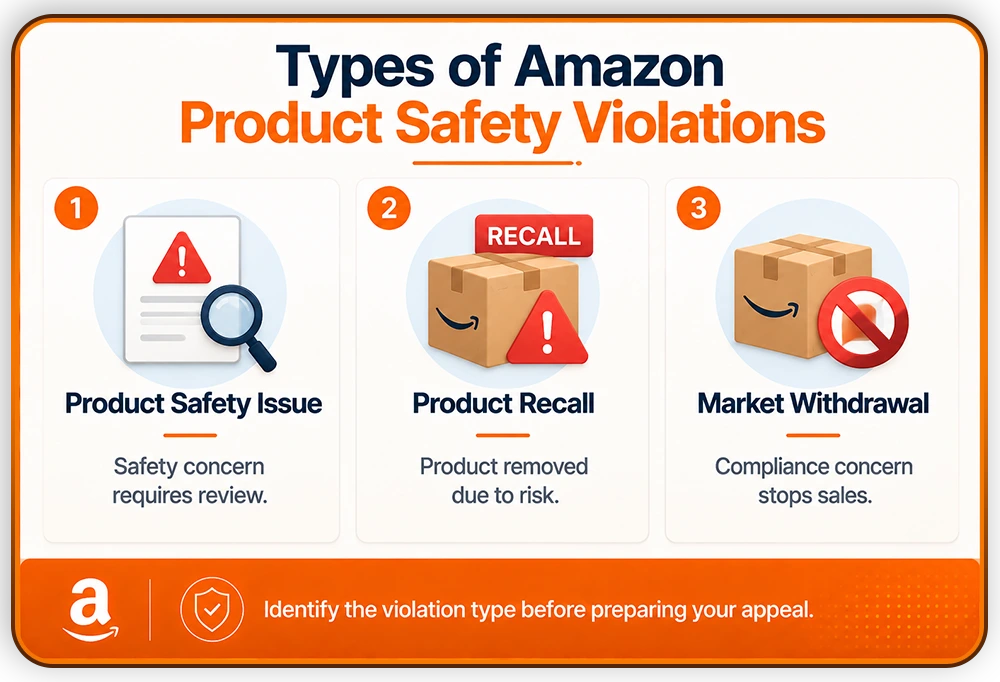
Amazon handles safety-related issues differently depending on the nature of the concern. The required response and documentation depend on the specific violation mentioned in the performance notification. Sellers should first identify the type of safety action taken before preparing an appeal.
1. Product Safety Issue
A Product Safety Issue occurs when Amazon identifies a potential safety concern with a product. This may result from customer complaints, safety reports, compliance checks, or other signals indicating that a product may not meet Amazon’s safety requirements.
To appeal a Product Safety Issue, sellers should provide:
- A detailed explanation of the root cause behind the safety concern, including how the issue occurred.
- Safety testing reports or compliance documents showing that the product meets applicable safety standards.
- Certificates or regulatory documentation required for the specific product category.
- Product images from all angles showing the actual product, packaging, labels, and safety markings where applicable.
- Supplier invoices and sourcing documents to verify product authenticity and supply chain information.
- Corrective actions already completed, such as updating labels, improving packaging, replacing defective inventory, or removing non-compliant units.
- Preventive measures explaining how future safety issues will be avoided
If Amazon believes a seller is operating another account to avoid enforcement action, it may treat this as a serious Section 3 policy violation.
2. Product Recall
A Product Recall occurs when Amazon determines that a product may create a safety risk for customers and requires action to prevent further sales or distribution. Amazon’s team monitors regulatory agencies and instantly suppresses listings for unsafe items to block new purchases.
To appeal or respond to a Product Recall, sellers should provide:
- Confirmation that sales of the affected product have been stopped.
- Details of inventory actions taken, including removal, disposal, or return of affected units when required.
- A manufacturer or supplier statement explaining the safety concern and corrective actions taken.
- Documentation confirming the product meets required safety standards after corrective actions.
- A corrective action plan explaining how the issue was resolved.
- Evidence that affected customers or inventory have been properly addressed, when applicable.
- Preventive measures to ensure similar issues do not occur with future inventory.
3. Market Withdrawal
A Market Withdrawal occurs when a product is removed from sale because of a compliance or safety concern, but it may not involve a formal consumer recall.
To appeal a Market Withdrawal, sellers should provide:
- The reason the product was withdrawn and the identified compliance concern.
- Evidence showing the corrective actions completed to resolve the issue.
- Updated compliance documents from the manufacturer, certifications, or testing reports if applicable.
- Proof that product listings, packaging, labels, or instructions have been corrected.
- Confirmation that affected inventory has been reviewed and handled appropriately.
- A prevention plan explaining the process improvements implemented to avoid future compliance issues.
The documentation Amazon requires depends on the product category, violation type, and details included in the performance notification. Sellers should avoid submitting generic appeals and instead provide evidence directly connected to Amazon’s stated concern.
What Causes a Product Safety Complaint on Amazon?
Product safety and customer complaints on Amazon tend to trace back to a small number of recurring sources.
1. Customer complaints: a buyer reports illness, injury, or a defect through a return, a review, or a direct report to Amazon
2. Internal detection: Amazon’s own systems flag patterns, such as an unusual spike in returns or complaint language tied to a specific ASIN
3. Routine compliance sweeps: Amazon checks an entire category against a regulation, sometimes triggered by a new rule. Amazon may conduct category-wide compliance reviews where products are evaluated against applicable safety requirements. Sellers may be asked to provide documentation even if the product has previously been listed without issue.
4. Missing or expired documentation: no certificate of compliance, lab test report, or safety data sheet on file when Amazon requests one
5. Food-specific triggers: expiration or labeling issues, allergen disclosure gaps, or handling and storage concerns for consumables
Two Ways Amazon Flags a Product for Safety Review
Most guidance on this topic treats every safety flag the same way, but there are really two distinct triggers, and they call for different responses.
The first is a straightforward compliance check. Amazon knows your product’s category requires certain documentation and asks you to produce it. This happens on new listings, during category-wide sweeps, after a complaint, or when a previous check wasn’t completed.
The second is category reclassification, and it’s the one sellers rarely see coming. Amazon’s system doesn’t just look at what your product physically is. It reads the claims in your own listing copy, and if that language matches a stricter regulated category, the product gets treated as if it belongs there. A wellness product marketed with language like “relieves” or “treats” can get pulled into medical device territory. A bag marketed with imagery or phrasing aimed at kids can get pulled into children’s product scope under the CPSIA, regardless of what the product actually is. In both cases, the documentation Amazon asks for is for the reclassified category, not the one you thought you were selling in. This distinction matters because it changes what a successful appeal looks like, covered further down.
Food and Product Safety Issues on Amazon: Is It Always About the Product Itself?
Not always. Some safety flags are actually about damaged or used-looking inventory, mislabeling, expired dating, or packaging that looks tampered with, rather than a genuine defect in the product itself. This distinction matters for your response. A labeling or packaging fix is a different corrective action than a product recall, and conflating the two in an appeal weakens it.
What Happens When Amazon Flags a Product Safety Issue?
Listing suppression or removal is typical, and it can happen without prior warning. FBA inventory tied to the ASIN may be held, and in some cases Amazon disposes of it rather than returning it to the seller. Read the notice closely, because it will specify what’s needed to appeal, or it will state directly that no appeal will be accepted. That second outcome is real and worth taking seriously rather than assuming every removal has a path back.
How to Appeal a Product Safety Issue on Amazon
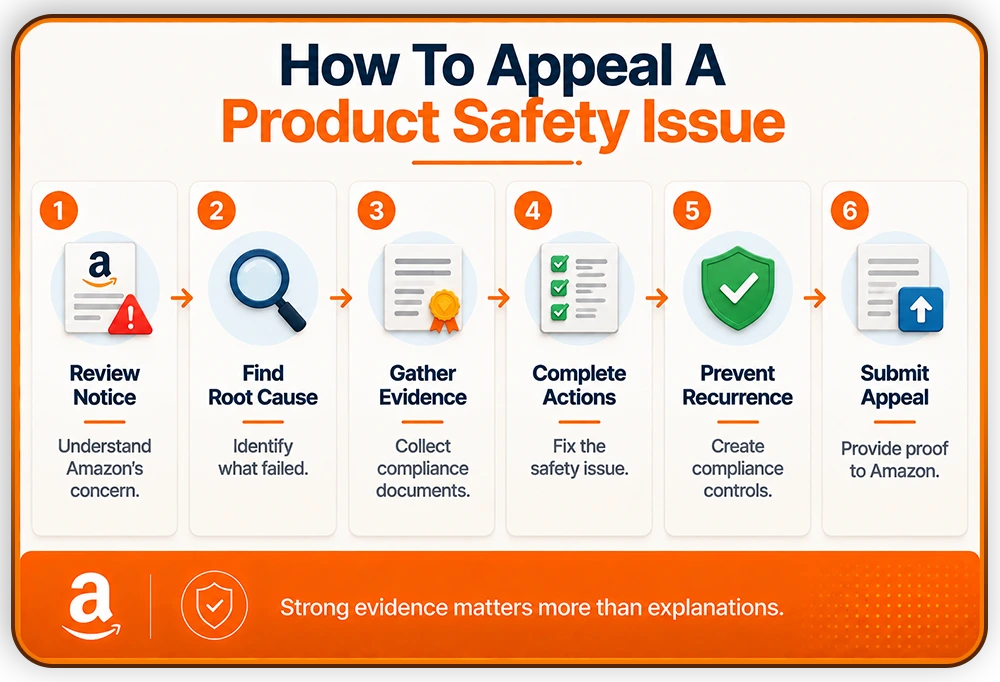
Confirm first whether the notice allows an appeal at all. Some final safety removals state outright that Amazon will not review further submissions. If a path exists, the appeal needs to follow the same three-part structure Amazon expects across every violation type: root cause, corrective actions already completed, and prevention going forward. Our full breakdown of the Amazon Plan of Action structure covers the format in detail, including a worked sample. The short version for a safety case is that root cause has to name the actual gap, whether that’s a missing certificate, an expired test report, or listing language that triggered a reclassification, and corrective actions need to be written in the past tense, already completed, not promised.
Submit through the Seller Central case log tied to the notice. General Seller Support may have limited ability to resolve product safety decisions directly.
What Documentation Does Amazon Require for a Product Safety Appeal?
The documents Amazon requests depend on the product category, violation type, and the details in the performance notification. Common examples include:
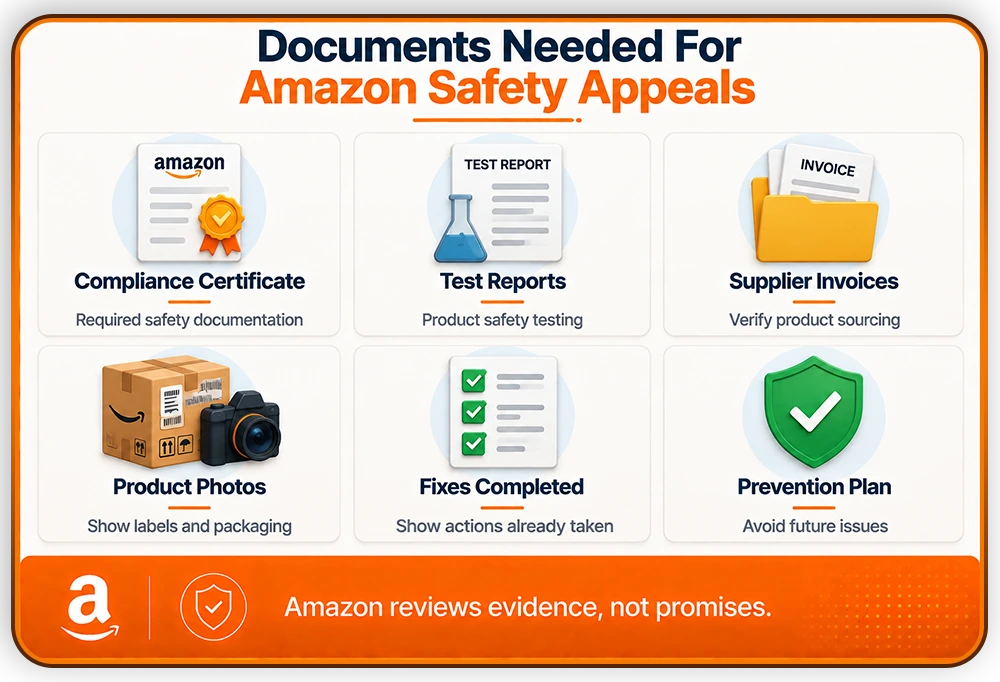
1. Certificate of Compliance (CPC): required for children’s products under the Consumer Product Safety Improvement Act (CPSIA)
2. Lab test reports: for certain safety investigations, Amazon may request testing from qualified laboratories, including ISO/IEC 17025 accredited laboratories
3. Safety Data Sheets (SDS): for chemical, cosmetic, or hazardous-adjacent products
4. UL or ASTM certification: depending on the product type, particularly for electronics and children’s products
5. Proof of regulatory registration: where applicable, such as FDA registration for certain product categories
6. Invoices and supplier documentation: to establish sourcing and chain of custody, which matters even in a pure safety case since Amazon may ask where the product came from
Amazon may provide a deadline specified in the performance notification. Sellers should treat that deadline as firm because missing documentation can delay or prevent reinstatement. If the documentation is already in hand and complete, the review itself can move quickly, sometimes within a few days. If it isn’t, treat the submission window as real working time rather than a deadline to beat with an incomplete file.
Appealing a Reclassification vs. a Documentation Gap
These two situations need genuinely different appeals.
If it’s a documentation gap, the fix is straightforward: produce the certificate, test report, or label file for the category Amazon has already assigned your product to.
If it’s a reclassification, submitting compliance paperwork for the new category is usually the wrong move, since you may not need it at all. The stronger appeal shows why the product doesn’t actually meet the regulatory definition of the stricter category, using the product’s real function and, where the trigger was listing language, a corrected version of that language. This is closer to the entitlement argument used in intellectual property cases than a standard compliance fix.
Product Safety Issue Amazon Appeal Example
Rather than hand over a fill-in-the-blank letter that won’t match your actual documentation, here’s the structure a real appeal follows for each of the two scenarios above.
Documentation gap example, structure only: root cause names the missing document specifically (“our Certificate of Compliance for ASIN B0XXXXXXXX had expired and was not renewed before the annual testing cycle”). Corrective actions list the new test completed, the lab used, and the date, in the past tense. Prevention describes a recurring compliance calendar with a named owner who tracks certificate expiration dates ahead of time.
Reclassification example, structure only: root cause explains what the product actually is and what specific listing language triggered the reclassification. Corrective actions show the listing copy already corrected, with a before-and-after comparison. Prevention describes a pre-publish review step that checks new listing copy against regulated-category trigger language before it goes live.
Both examples work because they name specifics. A root cause that could describe any seller’s product is the fastest way to get an appeal rejected, a pattern our guide on why Amazon appeals get rejected covers in more depth. Amazon’s reviewers process a high volume of these submissions and are trained to scan for verifiable specifics, not persuasive writing.
When Amazon Won't Accept a Product Safety Appeal
Real, documented cases exist where Amazon states a safety removal is final, and no appeal will be reviewed, usually tied to a serious or repeated incident rather than a first-time documentation gap. If that’s the language in your notice, resubmitting the same case repeatedly doesn’t tend to change the outcome.
A single compliance-related safety issue on one ASIN is uncommon to escalate into a full account-level action on its own. The risk rises with repeated issues across multiple listings, or with attempting to relist a product that already failed an appeal, which Amazon treats as a serious red flag rather than a fresh attempt. Escalation from a listing-level safety issue into something broader connects to the same account health mechanics covered in our guide to Section 3 account violations, since enough unresolved policy issues of any kind can pull an account’s health rating down regardless of category.
This is also where legal counsel can matter more than a standard appeal, particularly for reclassification disputes involving genuinely contested regulatory definitions, or for repeated final rejections with no clear path forward.
How to Prevent Future Product Safety Complaints
1. Keep compliance documentation current: don’t wait for a request to gather certificates and test reports; track expiration dates on a set schedule
2. Monitor return and complaint patterns: a rising return rate tied to safety language in reviews is an early signal worth investigating before Amazon flags it
3. Audit packaging and labeling regularly: especially for food and consumables, where allergen and expiration labeling issues are common triggers
4. Review your own listing language before publishing: words like “treats,” “relieves,” or “for children” can pull a product into a stricter regulated category even when that was never the intent
5. Vet suppliers for category-specific compliance: confirm CPSIA, ASTM, or FDA requirements are met before listing, not after a flag
Final Thoughts
A safety-related appeal carries more weight with the right documentation behind it than with a well-written letter alone, and that’s true whether you’re closing a compliance gap or fighting a reclassification you don’t think should apply. If a product safety complaint has your listing or account at risk, Back to Selling’s reinstatement service can review your case, identify which of these situations you’re actually in, and build the appeal around the evidence that matches it.

Frequently Asked Questions
What triggers a product safety complaint on Amazon?
Most commonly, a customer complaint, an internal Amazon detection system, a routine compliance sweep on a category, or missing documentation Amazon requested. Food products also get flagged for expiration and labeling issues specifically.
Can a product safety removal on Amazon be appealed?
Sometimes. The notice will state whether an appeal path exists. Many documentation-related removals are appealable with the right evidence, but Amazon does issue final removals for serious or repeated safety incidents that explicitly state no further appeal will be reviewed.
What documents does Amazon need for a product safety appeal?
It depends on the product category, but common requirements include a Certificate of Compliance for children’s products, accredited lab test reports, Safety Data Sheets, UL or ASTM certification, and supplier invoices establishing sourcing.
How long does an Amazon product safety appeal take?
Amazon does not publish a fixed timeline for all product safety appeals. Sellers should follow the deadline provided in their performance notification and submit complete documentation as soon as possible
Can a false product safety complaint get a listing removed?
Yes, a listing can be suppressed while Amazon investigates even if the complaint turns out to be unfounded. The appeal process and documentation requirements are the same either way, since the burden is on the seller to demonstrate the product meets safety requirements.