

- admin
- Blog
Amazon Plan of Action: Structure, Sample, and Why Most POAs Get Rejected
The notification arrives without warning. Your listings stop selling, your disbursements are held, and somewhere in the message Amazon asks you to submit a plan of action.
Most sellers respond within the hour. They search for an Amazon plan of action template or a sample plan of action for Amazon, adjust a few sentences, and send it. Then they wait, get rejected, and send a slightly different version of the same document. Each round makes the next one harder.
The problem is almost never writing quality. It is that Amazon is not reading your document the way you wrote it. Amazon is checking whether one specific question has been answered: can this seller be trusted not to cause this problem again? A plan of action that does not answer that question clearly will be rejected no matter how well it is written or how sincere it sounds.
This guide covers the structure Amazon expects, a complete worked Amazon POA sample, the correct format, the reasons appeals fail, and how the requirements change depending on what you were suspended for. It also covers what Amazon does not publish, because a lot of confident advice online fills those gaps with numbers nobody can verify.
What an Amazon Plan of Action Actually Is
An Amazon plan of action, usually shortened to POA, is a structured written response submitted through Seller Central when Amazon deactivates your account, deactivates a listing, or issues a policy violation that needs to be resolved. You submit it from the Account Health page, attached to the specific violation or deactivation you are addressing.
The important distinction is what kind of document it is. An appeal argues. A plan of action demonstrates. One asks Amazon to reconsider a decision. The other shows Amazon that the underlying problem has already been identified, fixed, and engineered out of your operation. Amazon’s review process is built to evaluate the second kind of document, which is why appeals written as the first kind tend to fail even when the seller is completely in the right.
Amazon typically requests a POA in these situations:
- Account deactivation: selling privileges removed across the whole account..
- Listing or ASIN deactivation: individual products removed while the account stays active.
- Product authenticity and counterfeit complaints: where sourcing documentation is the central issue.
- Intellectual property complaints: trademark, copyright, or patent claims filed by a rights owner.
- Performance metric breaches: order defect rate, late shipment rate, cancellation rate, or on-time delivery rate crossing Amazon's limits.
- Policy compliance violations: restricted products, listing policy, product condition, customer product reviews, or variation policy.
The document structure stays the same across all of these. What changes is the evidence you need behind it, which is covered further down.
The Three Parts of a Plan of Action for Amazon
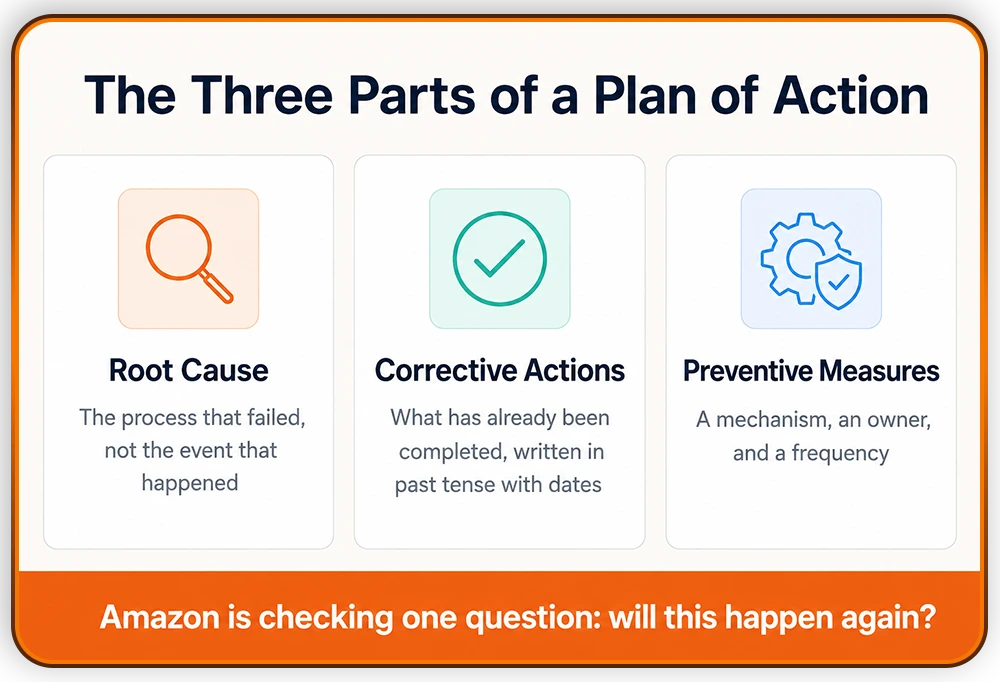
Every effective Amazon POA answers three questions in a fixed order. The order matters because reviewers read the root cause first, and a vague root cause usually decides the outcome before the rest of the document is read at all.
1. Root Cause
The root cause is the process that failed, not the event that happened.
This is where most plans collapse. “We had an oversight” is not a root cause. Neither is “a supplier sent us the wrong product.” Those describe an incident. Amazon is asking what in your operation allowed the incident to reach a customer.
Compare these two:
Weak: We had some late shipments during a busy period.
Strong: Our shipping confirmations were entered manually by one team member. When daily order volume rose above roughly 60 units in November, tracking uploads fell behind by up to 48 hours, and our late shipment rate reached 6.2 percent against Amazon’s 4 percent limit.
The second version names the process, the breaking point, the timeframe, and the measurable result. A reviewer can follow it. The first version could have been written by any seller about any violation, which is exactly the signal that gets a plan rejected.
Take ownership even when someone else made the mistake. If a freelancer, supplier, or fulfillment partner caused the problem, the root cause is that your process had no step that would have caught it. That framing is both more accurate and more persuasive than assigning blame, and Amazon reads blame-shifting as a sign the problem is not resolved.
2. Corrective Actions
Corrective actions are what you have already completed. Not what you intend to do.
This is a simple rule with a large effect. “We will remove the affected inventory” tells Amazon the problem is still live. “We removed all 340 units of the affected ASIN on March 4 and submitted an FBA removal order, confirmation attached” tells Amazon the problem is contained.
Write every corrective action in the past tense with a date, and pair it with evidence where evidence exists. Typical corrective actions include:
- Affected listings deactivated or corrected, with the specific ASINs named.
- Inventory removed or destroyed, with the removal order confirmation.
- Supplier documentation obtained, including invoices that meet Amazon's requirements.
- Affected buyers were contacted or refunded, with transaction records.
- Open orders shipped and tracking backfilled, where the violation was shipping-related.
- Non-compliant supplier relationships ended, with the termination documented.
Complete the actions first, then write about them. Doing it the other way around is the most common self-inflicted rejection in the entire process.
3. Preventive Measures
Prevention is the section Amazon weighs most heavily, because it is the only part of the document that actually answers the trust question.
A preventive measure needs three things to count: a mechanism, an owner, and a frequency. “We will monitor our account health more closely” has none of those and reads as a promise. “Our operations manager reviews the Account Health dashboard every Monday and logs the review in our compliance sheet” has all three and reads as a system.
Strong preventive measures usually replace human attention with structure:
- Automation replacing manual work, such as automated tracking upload or Shipping Settings Automation instead of manually set handling times.
- A scheduled review with a named owner, for example, a weekly account health check or a monthly listing audit.
- A documented supplier qualification process, requiring compliant invoices and verifiable business details before any purchase order.
- Team training with a date and a syllabus, rather than a general statement that staff were reminded of the policy.
- A pre-listing compliance check, particularly for intellectual property and restricted product risk.
Amazon Plan of Action Format: What the Document Should Look Like
Amazon does not publish a required Amazon POA format, which is part of why the document causes so much anxiety. What Amazon does make clear through its rejection patterns is that reviewers process a high volume of these and reward documents that can be read quickly.
Here is a plan of action format for Amazon that works across violation types:
Subject: Plan of Action for [account or listing reinstatement]
Case ID / Notification date: [reference from the notice]
Affected ASINs: [list]
1. Root cause
– The specific process failure that allowed the violation
– Timeframe, affected ASINs or orders, and the relevant metric
2. Corrective actions completed
– Action, with date completed
– Action, with date completed
– Reference to attached evidence for each
3. Preventive measures implemented
– Process change, with owner and frequency
– System or automation change, with implementation date
– Ongoing control, with how it will be monitored
Attachments:
– [Each document, labeled to match the claim it supports]
Formatting Rules
A few formatting rules carry real weight:
1. Length: One to two pages is enough for most cases. Reviewers are not scoring effort.
2. Structure: Use bullets and short paragraphs. Dense prose gets skimmed.
3. Tone: Factual and neutral. No emotional appeals, no blame directed at Amazon, buyers, or competitors, and no legal threats.
4. Evidence: Attach documents that are legible, unedited, and clearly tied to a specific claim. Extra documents that support nothing slow the review down.
5. Scope: If the notice names more than one issue, address each one separately. A single unresolved item can hold up the entire reinstatement.
Amazon Plan of Action Sample
Below is a complete Amazon plan of action sample for a product authenticity complaint, which is the most documentation-heavy category and therefore the most useful example. Read it for structure and specificity, not for language to reuse.
Subject: Plan of Action for reinstatement of ASIN B0XXXXXXXX
Notification date: March 1, 2026
1. Root cause
We received a product authenticity complaint on ASIN B0XXXXXXXX. On investigation, we identified that this ASIN was sourced from a secondary supplier we added in October 2025 to cover a stock shortage ahead of the holiday period.
Our purchasing process at the time required a signed supplier agreement but did not require a compliant purchase invoice before goods were received. As a result, we accepted 500 units from this supplier against a proforma invoice, which does not meet Amazon’s documentation requirements and could not be used to verify the supply chain when the complaint was raised. Our primary supplier for this ASIN was fully documented. The gap existed only in the secondary sourcing path, and our process had no control point that would have flagged it.
2. Corrective actions completed
– On March 2, 2026, we deactivated ASIN B0XXXXXXXX and stopped all sales of the affected units.
– On March 3, 2026, we submitted an FBA removal order for the remaining 218 units sourced from the secondary supplier. Removal order confirmation is attached.
– On March 4, 2026, we obtained a compliant commercial invoice from our primary supplier covering 1,000 units of this ASIN, dated within the last 365 days, showing supplier and buyer details, item description, and quantity. The invoice is attached and the ASIN is circled.
– On March 5, 2026, we ended our purchasing relationship with the secondary supplier. Written notice of termination is attached.
– On March 5, 2026, we reviewed our remaining catalog and confirmed that no other active ASIN was sourced through the same path.
3. Preventive measures implemented
– We have added a mandatory documentation gate to our purchasing process. As of March 6, 2026, no purchase order is issued until a compliant invoice template has been confirmed with the supplier in writing. Our purchasing manager owns this step.
– We have introduced a supplier qualification checklist covering business registration, verifiable contact details, and an invoice sample review. All existing suppliers were re-qualified on March 6, 2026, and the completed checklists are attached.
– Our operations manager now audits the sourcing documentation for every active ASIN on the first Monday of each month and records the audit in our compliance log.
– We have removed emergency sourcing as an approved practice. Stock shortages are now managed through forecasting adjustments and earlier reorder points rather than unqualified suppliers.
Attachments: FBA removal order confirmation, supplier invoice, supplier termination notice, supplier qualification checklists, compliance log template.
Why Copying This Sample Will Not Work
Read that sample carefully, and you will notice something. Almost every sentence contains a detail that only that seller could know. The date the supplier was added, the reason, the unit counts, the specific control that was missing.
That specificity is the entire value of the document. Strip it out and replace it with your own generic version, and you produce exactly the kind of appeal that gets rejected, because a root cause that could apply to any seller tells Amazon the real problem has not been found.
Amazon reviewers see recycled samples constantly. Submitting one that does not match your actual operation is worse than submitting nothing, because it burns a review cycle and reduces your credibility for the next attempt. Use the structure, but investigate your own case and write your own content.
How to Write a Plan of Action for Amazon, Step by Step
Step 1: Read The Notice Precisely
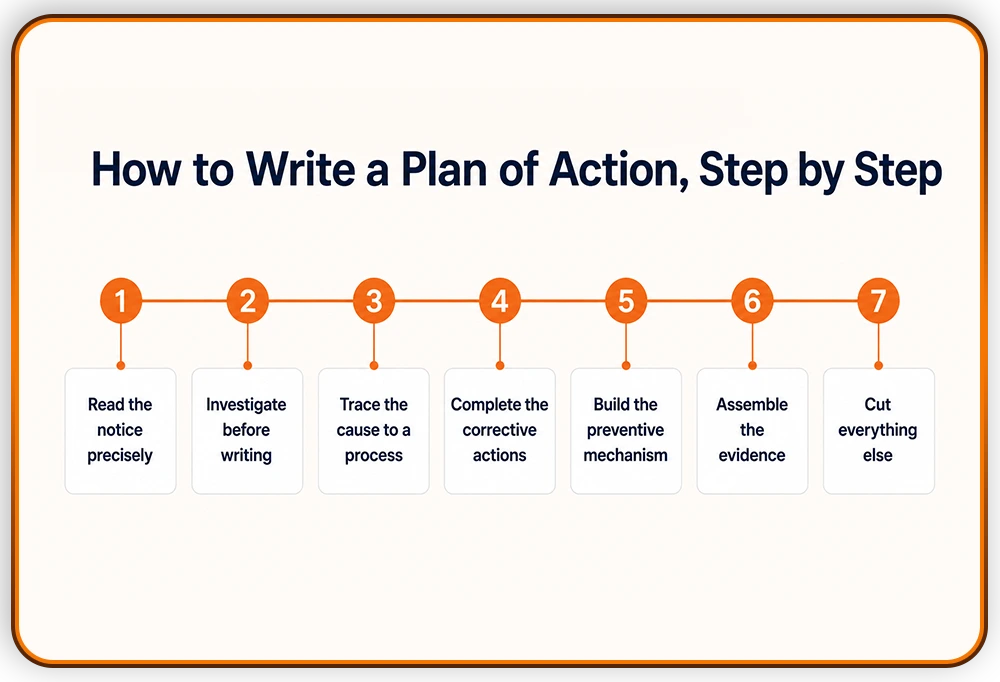
Identify the exact policy cited, the affected ASINs, the metric named if there is one, and the deadline Amazon gives you. The notice defines the scope of your response. Anything you address that the notice did not raise is noise, and anything the notice raised that you skip is a reason to reject.
Pay particular attention to the deadline. Amazon states it in the notice itself and it is not consistent across violation types. Some notices give 72 hours, some give less, some give considerably more. Any article that tells you the deadline is always a fixed number is guessing. Use the one in your own notification.
Step 2: Investigate Before Writing
The instinct to submit within minutes is understandable and it costs sellers accounts. Spend the time to trace what actually happened, even if that means using most of the window you were given. A well-researched plan submitted near the deadline consistently outperforms a rushed one submitted immediately.
Step 3: Trace the Cause Back to a Process
Keep asking why until the answer is a system rather than an event. A late shipment happened because tracking was uploaded late, which happened because uploads were manual, which happened because nobody had set a volume threshold at which the manual process would break. The third answer is the root cause. The first two are symptoms.
Step 4: Complete the Corrective Actions
Do the work, then document it with dates. This is the step sellers most often reverse.
Step 5: Build the Preventive Mechanism
Mechanism, owner, frequency. If a preventive measure is missing one of the three, it is a promise rather than a control.
Step 6: Assemble the Evidence
Attach only what supports a claim you have made. Label each document so a reviewer can match it to the relevant section without hunting.
Step 7: Cut Everything Else
Remove your business history, your revenue figures, your years of good standing, and anything that reads as persuasion. If a sentence is not root cause, corrective action, prevention, or evidence, it is working against you.
Why Most Amazon Plans of Action Get Rejected
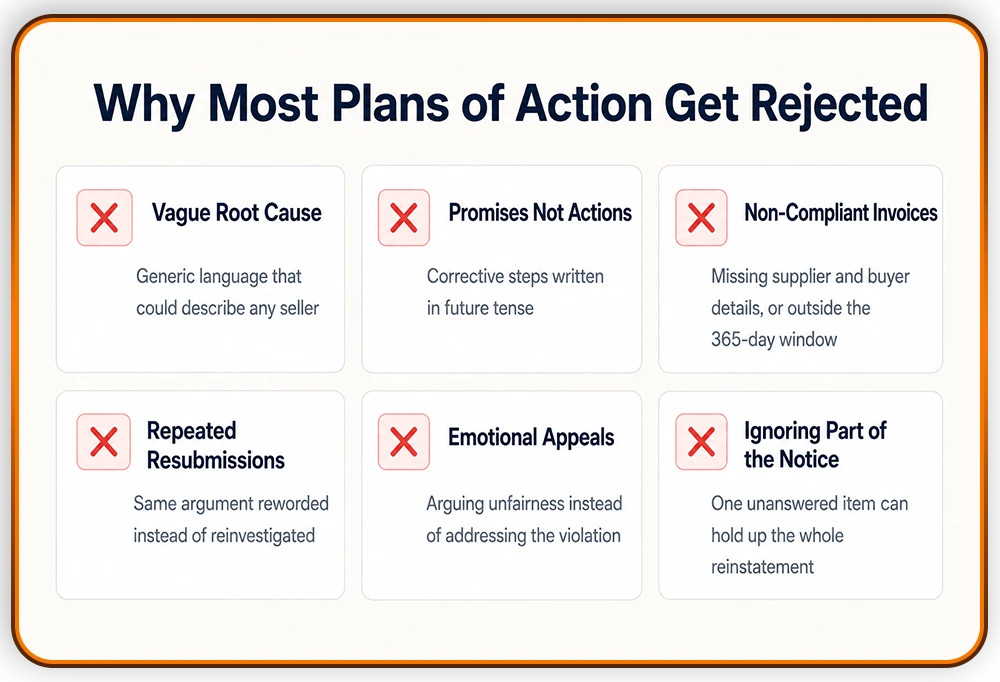
Most Amazon Plans of Action fail because they don’t clearly identify the actual problem or demonstrate that it has been fully resolved. Generic explanations, incomplete documentation, and repeated submissions can all weaken your case.
- Vague Root Cause: Generic statements and boilerplate language make it difficult for Amazon to see what actually caused the violation. Your root cause should be specific to your account and based on a genuine investigation..
- Promises Instead of Completed Actions: Writing corrective actions in the future tense can suggest that the problem still exists. Show Amazon what you have already done to correct the issue and remove the risk.
- Incomplete or Non-Compliant Invoices: For authenticity and counterfeit cases, invoices must meet Amazon's documentation requirements. They should include the supplier's details, your matching buyer information, item descriptions, quantities, and dates within the required period. The quantities should also support the sales volume for the affected ASIN. Retail receipts, packing slips, order confirmations, and pro forma invoices generally do not satisfy these requirements.
- Repeated Resubmissions: Sending slightly edited versions of a rejected Plan of Action rarely solves the underlying problem. Reinvestigate the violation, identify what was missing, and rebuild the submission around the new findings.
- Emotional Appeals: Explaining that the suspension is unfair or damaging to your business does not address Amazon's primary concern. Focus on the violation, its root cause, corrective actions, and measures that prevent recurrence.
- Ignoring Part of the Notice: Address every issue identified in Amazon's notice. Leaving even one violation or concern unanswered can result in another rejection.
- Opening a New Account: Creating another selling account while suspended can make the situation significantly worse. Amazon restricts operating additional seller accounts without approval, and linked accounts may also face enforcement.
A Note on Statistics: You will find confident percentages online for how many appeals fail and how long reviews take. Amazon does not publish either figure. Treat any specific number you see as an estimate rather than a fact.
How the Plan of Action Changes by Violation Type
The three-part structure holds for every case. The burden of evidence is what shifts.
1. Amazon Plan of Action for Infringement Complaints
An Amazon plan of action for infringement follows the same three-part structure but rests on authorization rather than sourcing. For a trademark, copyright, or patent complaint filed by a rights owner, the strongest outcome is usually a retraction from the complainant, because a withdrawn complaint resolves faster than a contested one. Where retraction is not possible, the plan needs authorization documentation, proof that the infringing content or listing was removed, and a pre-listing intellectual property verification step in the prevention section.
Rights owner complaints and Amazon’s automated intellectual property filters are different mechanisms with different resolutions, and treating one like the other wastes a review cycle. SPCTEK’s guide to IP violations breaks down how the different complaint types work and what evidence each one calls for.
2. Amazon Plan of Action for Counterfeit and Authenticity Complaints
An Amazon plan of action for counterfeit claims carries the heaviest documentation burden of any category. The document itself matters less than the invoices behind it, and the invoice requirements listed earlier are where most of these cases are won or lost. A counterfeit POA with a flawless root cause and a non-compliant invoice will still fail. Sourcing controls belong in the prevention section, expressed as a documentation gate rather than an intention to be more careful.
3. Plan of Action for Performance and Metric Suspensions
Performance cases are the most fixable, because the corrective action is operational rather than evidentiary. The relevant thresholds are:
- Order defect rate: below 1 percent, measured on a rolling basis and combining negative feedback, A-to-Z Guarantee claims, and credit card chargebacks.
- Late shipment rate: below 4 percent across both the 10-day and 30-day windows.
- Pre-fulfillment cancellation rate:below 2.5 percent.
- Valid tracking rate:above 95 percent. This metric was expanded in January 2025 to cover all carriers rather than only Amazon-integrated ones.
- On-time delivery rate: at least 90 percent without promise extensions for seller-fulfilled listings.
One recent change matters here and is not yet reflected in most published guidance. Effective February 28, 2026, Amazon updated how it enforces the on-time delivery rate requirement. The 90 percent threshold itself did not change. What changed is the consequence. Previously, an OTDR below 90 percent could result in all of your seller-fulfilled listings being deactivated. Under the updated approach, Amazon deactivates only the listings contributing most to the shortfall, leaving the rest active. Accounts significantly below the threshold, or repeatedly below it, can still face full deactivation of seller-fulfilled listings.
The practical effect is that a partial OTDR deactivation is now a warning shot rather than a full stop, and the correct response is to fix the specific listings named in the notice and evidence that fix in the plan. Deactivated listings are reinstated through the Account Health page.
SPCTEK’s breakdown of Amazon’s seller performance standards covers how these metrics interact and where the measurement windows differ, which is useful when a notice cites a figure that does not match what your dashboard currently shows.
4. Plan of Action for a Full Account Deactivation
When the whole account is deactivated, review every open item on the Account Health page rather than only the issue named most prominently in the notice. Address each one as its own root cause, corrective action, and prevention set within the same document. Reinstatement is generally held until all of them are resolved.
How the Account Health Rating Fits In
The Account Health Rating gives you a way to see risk building before a notice arrives, and understanding how it moves helps you write a more credible prevention section.
The Account Health Rating runs on a scale from 0 to 1,000 and is based on roughly the last 180 days of activity. Every new account starts at 200. The bands are:
- 200 and above: healthy, shown in green.
- 100 to 199: at risk of deactivation, shown in yellow.
- Below 100: unhealthy, shown in red, and eligible for deactivation.
Points are deducted when violations are recorded and added back when violations are successfully resolved. Most violations cost between 2 and 8 points, depending on whether Amazon classifies them as low, medium, high, or critical impact. Critical violations, which include counterfeit and search ranking manipulation, can take the score to zero immediately regardless of where it stood before. The score also rises with clean selling volume, at roughly 4 points for every 200 orders fulfilled without a defect over the trailing 180 days.
Two implications matter for anyone writing a plan of action. First, because the score scales with sales volume, a drop in sales can pull your AHR down even when your compliance record has not changed. Second, resolving a violation successfully restores the points it cost, so clearing older violations in the right order is a real recovery lever rather than just housekeeping.
Amazon also runs Account Health Assurance, which is available to sellers maintaining an AHR of 250 or above with no unresolved critical violations. Enrolled sellers are contacted before enforcement action rather than after it. If your account is currently healthy, this is worth enrolling in now, because it is not available to you once the score has already fallen.
When to Write Your Own POA and When to Get Help
Writing your own plan is realistic when the violation is single and clearly stated, you understand which policy was cited, you can trace the root cause to a specific process, and the supporting documentation already exists in a compliant form.
Getting help becomes the better decision when one or more of these is true:
- Previous appeals have already been rejected. Each rejection narrows the path, and repeating the same approach rarely changes the outcome.
- The root cause is genuinely unclear. If you cannot explain why the violation happened, no amount of careful writing will produce a plan that passes.
- Multiple violations are stacked. Several open issues in one document is a structuring problem as much as a writing one.
- The case involves counterfeit or intellectual property claims with contested documentation. These carry the heaviest evidence burden and the least room for error.
- The account has been deactivated long enough that standard appeal routes are exhausted.
Whatever route you take, the honest test of any reinstatement help is whether it starts with a diagnosis rather than a promise. A credible assessment tells you the root cause, whether your documentation actually meets Amazon’s requirements, and a realistic view of your odds. Anyone quoting a success rate before looking at your case is selling confidence rather than analysis.
Conclusion
If you have received a notice, the sequence is the same regardless of violation type. Read the notice and identify exactly what was cited. Investigate until the cause is a process rather than an event. Complete the corrective actions and document them with dates. Build preventive controls with an owner and a frequency. Attach evidence that matches your claims. Then cut everything that does not belong.
If you have not received a notice, the most useful thing you can do is check your Account Health page this week, resolve anything sitting unaddressed, and enroll in Account Health Assurance while your rating still qualifies. Almost every seller who ends up writing a plan of action under pressure could have seen the risk building beforehand.

Frequently Asked Questions
How long should an Amazon plan of action be?
Most effective plans run one to two pages. There is no published limit, and length does not improve outcomes. If a sentence is not root cause, corrective action, prevention, or a reference to evidence, remove it.
How long does Amazon take to review a plan of action?
Amazon does not publish a review time, and it varies by violation type and complexity. Counterfeit, intellectual property, and account-wide cases generally take longer than single-listing or performance issues. Any specific figure you see quoted online is an estimate.
How many times can you submit a plan of action?
Amazon does not publish a maximum. In practice, repeated submissions with only minor edits reduce your chances rather than improving them. If a plan is rejected, investigate again and rebuild it rather than reword the version that failed.
Should you admit fault in your POA?
Yes, where your process was responsible, and phrased as ownership rather than apology. State what failed and what you changed. Avoid blaming Amazon, buyers, competitors, or suppliers, even when a supplier was involved, because the process gap was still yours.
Can you use an AI-generated plan of action?
Amazon does not prohibit AI-assisted writing, but generic AI output fails for the same reason templates do. It produces a root cause that could describe any seller. If you use AI to help with structure or clarity, the investigation and the specific facts still have to be yours.
What documents should you attach to a plan of action?
Only documents that support a claim in the plan. Common ones include supplier invoices meeting the 365-day requirement, FBA removal confirmations, refund records, supplier agreements or termination notices, compliance certificates, and training or process documentation. Label each one to match the section it supports.
What is the difference between a plan of action and an appeal?
An appeal is the submission itself, made through Seller Central. The plan of action is the document inside it. What sellers call an Amazon plan of action appeal is really both together, and an appeal without a properly structured POA is just a request to reconsider, which is the weakest possible form of the submission.
2 Responses