
- admin
- Blog
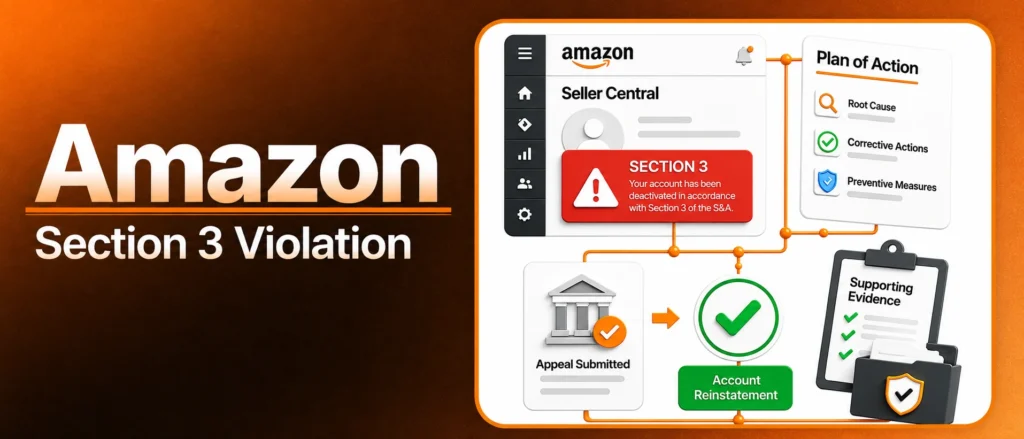
Amazon Section 3 Violation: Causes, Appeal Process & Account Reinstatement Guide
You open Seller Central and see it: your account has been deactivated in accordance with Section 3 of the Amazon Business Solutions Agreement. There’s no listing named and no product flagged, just a case number and a wall of legal language. Your funds are on hold, and your business has stopped moving. That notice is intentionally short on detail, and the panic that follows is a normal reaction, not an overreaction. A Section 3 violation is serious, but it is not automatically the end of your account. Sellers who understand what triggered it and respond with a clear, evidence-backed appeal can and do get reinstated.
What Is an Amazon Section 3 Violation?
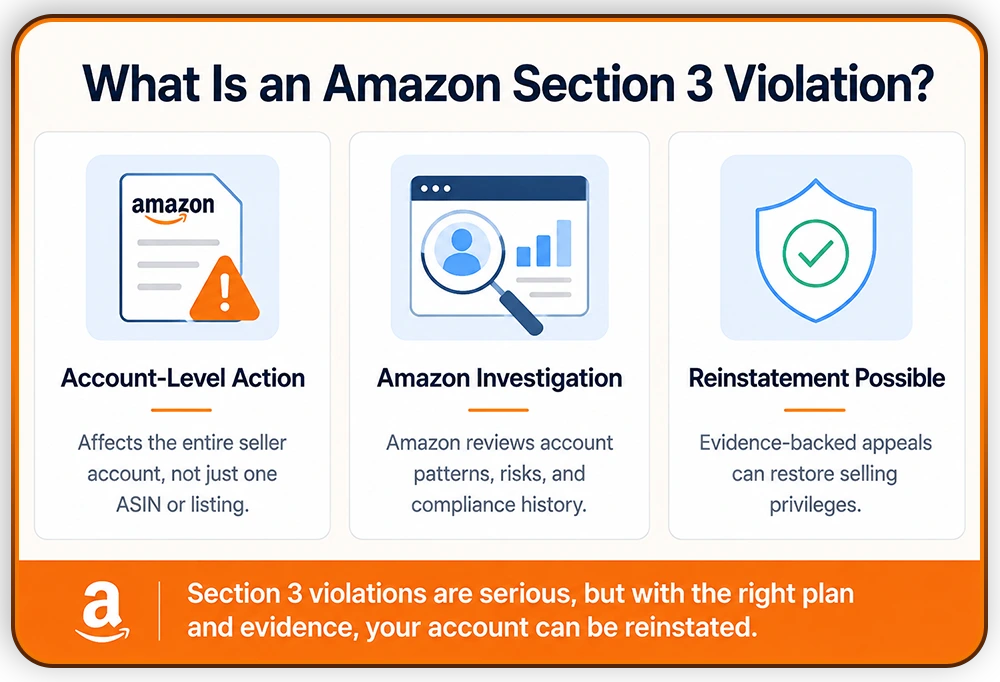
An Amazon Section 3 violation happens when Amazon deactivates or threatens to deactivate an entire seller account under the Term and Termination clause, Section 3, of the Amazon Services Business Solutions Agreement. Unlike a single listing suspension, it affects the whole account, and every seller agrees to this clause the moment they register to sell.
This distinction matters because it changes how you respond. A listing suspension is usually tied to one product and one policy. A Section 3 violation is tied to the account itself, which means Amazon’s review team is looking at patterns across your whole selling history, not a single mistake on a single ASIN.
What Is Section 3 of Amazon's Business Solutions Agreement?
Section 3 of the Business Solutions Agreement (BSA) is titled Term and Termination. It sets out when the agreement starts, how either side can end it, and the specific circumstances under which Amazon can suspend or terminate a seller’s account. Every seller accepts this section during registration, whether they read it or not, and it stays in force for as long as the account is active.
The clause gives Amazon the right to act on five grounds:
- Uncured material breach: you did not fix a breach of the agreement within 7 days of a cure notice, unless the breach exposes Amazon to liability toward a third party, in which case Amazon can shorten that window
- Deceptive, fraudulent, or illegal activity: Amazon's controls flagged, or confirmed, that the account was used this way
- Harm to others: your account activity harmed, or could harm, other sellers, customers, or Amazon's own business interests
- Account Health Rating below threshold: unresolved policy violations pulled your score below the level Amazon requires to keep selling
- Legal requirement: Amazon is required by law to suspend or end the account
Separately, Amazon can also end the relationship for convenience, with 30 days’ notice, which has nothing to do with a violation. When Amazon does act under Section 3, it’s supposed to notify the seller of the reason and any appeal options, except in cases where sharing that detail could interfere with a fraud investigation. That’s the main reason so many Section 3 notices read as vague. Amazon is often deliberately withholding specifics.
What Is a Section 3 Amazon Suspension?
A Section 3 suspension and a Section 3 termination are not the same thing, and the difference decides whether reinstatement is realistic.
A suspension is generally recoverable. Amazon has paused the account while it investigates or waits for the seller to fix something, and reinstatement is possible once the seller provides satisfactory evidence. A termination based on deceptive, fraudulent, illegal activity, or harm to customers, sellers, or Amazon’s business interests is treated as far more serious and can be more difficult to reverse, since Amazon considers the underlying activity a significant marketplace risk.
In practice, most sellers see the same pattern regardless of which one applies to them: listings go down, payouts get held, and the notice doesn’t name a specific SKU or order. That’s normal. It does not mean Amazon made an administrative error.
There’s also a timing difference worth knowing. A suspension tied to Account Health Rating or document verification tends to move on a predictable path: Amazon asks for evidence, reviews it, and either reinstates or asks for more. A termination tied to fraud or harm often skips that back and forth entirely, since Amazon’s position from the outset is that the account shouldn’t be operating at all. That’s why the tone and evidence in your appeal need to match the actual ground cited, not a generic “please reinstate me” request.
Why Amazon Issues Section 3 Deactivations: Common Causes
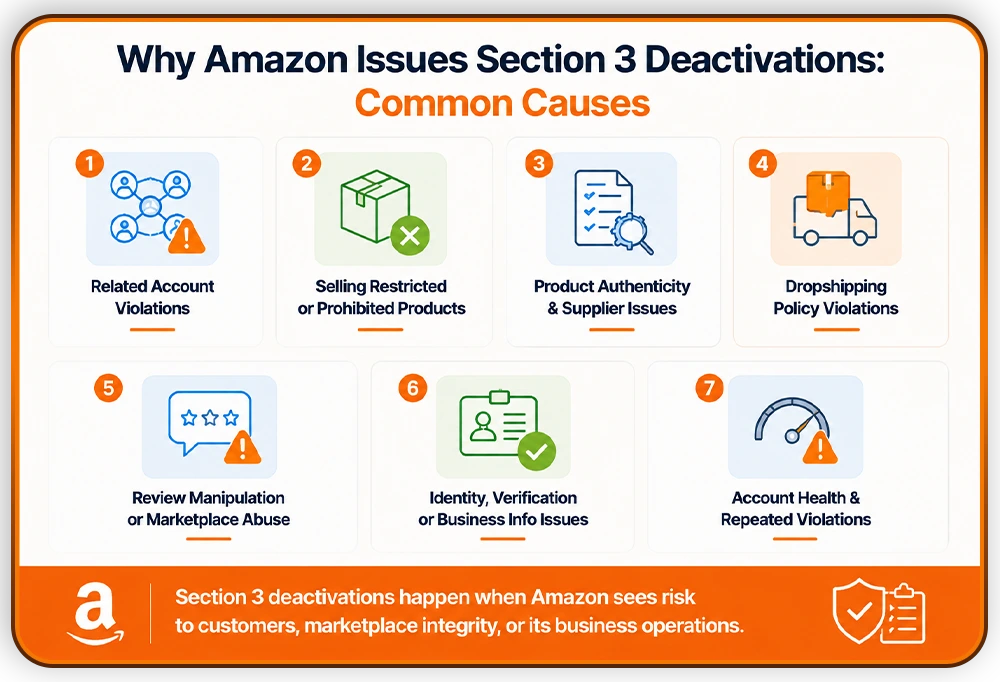
Section 3 deactivations tend to cluster around a handful of recurring causes. Knowing which one applies to your account is the first real step toward fixing it.
An Amazon Section 3 deactivation happens when Amazon determines that a seller account may create a risk to customers, marketplace integrity, or Amazon’s business operations. Unlike a standard listing suspension, Section 3 enforcement focuses on the seller account as a whole.
Amazon does not always provide the exact trigger behind the deactivation notice. In many cases, sellers receive a general Section 3 notification without a specific ASIN, order, or event being mentioned. This is because Amazon evaluates multiple account signals before taking account-level action.
The most common reasons Amazon issues Section 3 deactivations include:
1. Related Account Violations
Amazon closely monitors linked accounts and connections between seller accounts. A seller account may be deactivated if Amazon identifies an unauthorized relationship with another account that has compliance issues.
Common connection signals include:
- Shared business information
- Shared payment methods
- Shared devices or login activity
- Shared addresses
- Similar operational information
If Amazon believes a seller is operating another account to avoid enforcement action, it may treat this as a serious Section 3 policy violation.
2. Selling Restricted or Prohibited Products
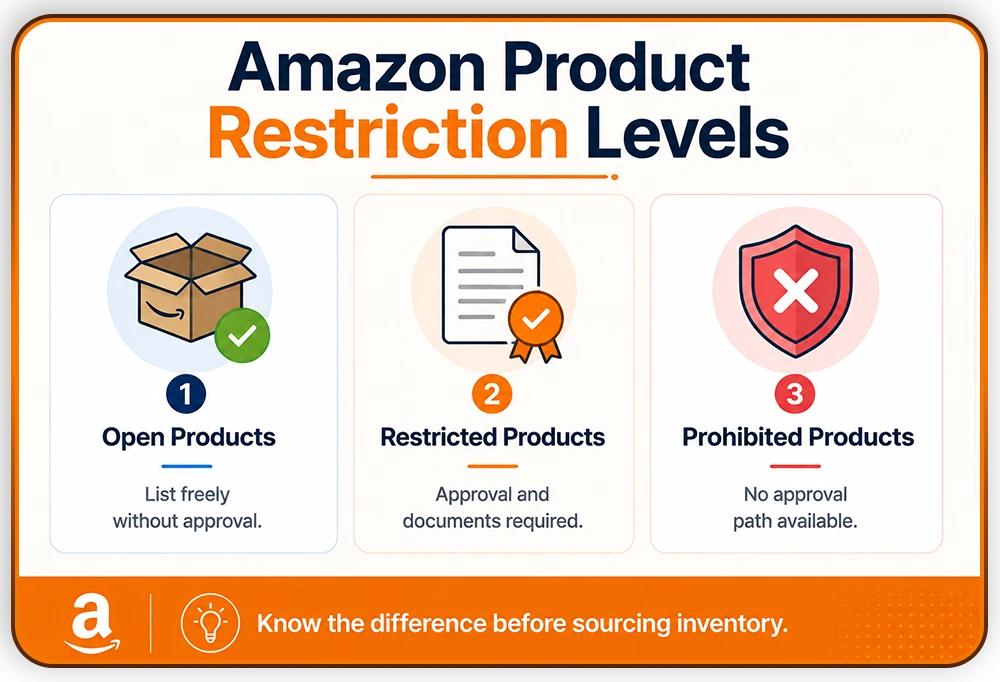
Selling products that violate Amazon’s Restricted Products Policy can lead to account-level enforcement, especially when products require approval, are prohibited, or create customer safety risks. While some restricted product issues begin as listing-level violations, Amazon may take broader account action under Section 3 when it identifies repeated violations, intentional policy violations, or significant compliance concerns.
Examples include:
- Listing restricted products without required approval
- Selling products that require compliance documentation without providing it
- Offering prohibited products
- Misclassifying products to avoid category restrictions
- Selling regulated products without required certifications or safety documents
Amazon may request documentation such as:
- Compliance certificates
- Safety test reports
- Manufacturer information
- Authorization documents
- Supplier invoices
A seller facing Section 3 action related to restricted products must show that the issue was identified, affected listings were corrected or removed, and a process was created to prevent future compliance failures.
3. Product Authenticity and Supplier Documentation Issues
Amazon expects sellers to maintain a reliable supply chain and provide valid documentation when requested.
Section 3 action may occur when Amazon identifies concerns such as:
- Unverified suppliers
- Invalid or incomplete invoices
- Supplier information that cannot be confirmed
- Products that cannot be traced back to the manufacturer or distributor
- Repeated authenticity complaints
A successful response requires more than submitting invoices. Sellers must demonstrate that they have improved their sourcing and verification process.
4. Dropshipping Policy Violations
Amazon requires sellers to maintain control over the customer experience. Dropshipping can become a Section 3 issue when sellers use another retailer or supplier in a way that violates Amazon’s requirements.
Common problems include:
- Shipping products with another retailer's packaging
- Purchasing products from another marketplace after receiving an order
- Failing to identify themselves as the seller
- Losing control over delivery and customer service quality
To resolve this type of violation, sellers need to explain how their fulfillment process has changed and how future orders will comply with Amazon’s dropshipping requirements.
5. Review Manipulation or Marketplace Abuse
Amazon takes action against activities that affect the trustworthiness of customer reviews and marketplace competition.
Examples include:
- Incentivized reviews
- Review exchanges
- Purchased reviews
- Manipulating product ratings
- Misleading customer interactions
A Section 3 appeal related to marketplace abuse must explain what caused the issue, what actions were taken to remove the problem, and what controls are now in place.
6. Identity, Verification, or Business Information Issues
Amazon may deactivate accounts when seller information cannot be verified or does not match the information provided during registration.
Common issues include:
- Mismatched business documents
- Incorrect identity information
- Bank account verification problems
- Outdated business records
- Failure to complete verification requests
Sellers must provide accurate documentation and explain how they will maintain compliance with Amazon’s verification requirements.
7. Account Health and Repeated Policy Violations
A single policy issue does not always result in Section 3 enforcement. However, repeated unresolved violations can indicate a broader compliance problem.
Amazon may consider:
- Multiple policy warnings
- Unresolved Account Health issues
- Repeated listing violations
- Failure to respond to previous warnings
- Patterns of non-compliance
When preparing a Section 3 appeal, sellers should address not only the final violation but also any previous issues that contributed to Amazon’s decision.
How to Know If Your Account Was Deactivated Under Section 3
An Amazon seller account deactivated under Section 3 has a recognizable signature, even though the notice itself rarely spells out the exact cause.
- Check your Account Health page: Seller Central will show the account as deactivated here, alongside your Account Health Rating
- Check the wording: look for the exact phrase “Section 3 of the Amazon Services Business Solutions Agreement” in the email or the Seller Central case. A standard performance warning naming a specific policy is a different issue, not a Section 3 Amazon deactivation
- Check the scope:this action hits the entire account, every listing across every marketplace, not one ASIN or category
- Read the full notification: the required steps to reactivate are listed under a “How do I reactivate my account” section near the bottom of the notice, usually asking for supply chain documents such as invoices, supplier information, or letters of authorization
- Check for missing detail: most notices won't name the listing, order, or document that triggered the review. That's standard when fraud or account integrity is in question, not evidence of an Amazon error
What not to do first: don’t open a new account to keep selling, since it creates a related account violation on top of the original one. Don’t ignore the case. And don’t file a generic appeal just to have something on record. A rushed first appeal is one of the more common reasons an Amazon seller account deactivated under Section 3 stays deactivated longer than it needs to.
How to Appeal an Amazon Section 3 Violation
Appeal quality matters more than appeal speed. Amazon’s review team isn’t looking for an apology or a promise to do better. It’s looking for three specific things: a clear root cause, evidence that supports it, and proof that the underlying issue has actually been fixed.
Submit your appeal through the case in Seller Central, not through Seller Support chat. Seller Support can answer general questions, but the case itself is where a real review happens.
How to Write a Plan of Action for Amazon Section 3
A strong Plan of Action for a Section 3 violation covers three parts, in order:
- Root cause: state specifically what happened, backed by evidence such as invoices, screenshots, or account activity logs. Vague language here is the single most common reason appeals get rejected
- Immediate action taken: describe exactly what you've already fixed, whether that's separating a related account, replacing a supplier, or correcting a document mismatch
- Preventive steps:explain the process or system changes that stop the same issue from happening again, not just a promise that it won't
Amazon Section 3 Appeal Template
There isn’t a single fill-in-the-blank template that works for every Section 3 case, because the root cause varies so much from account to account. What does hold constant is a strong POA structure:
Opening Statement: Briefly acknowledge the issue and explain that corrective actions have been taken.
Root Cause: Clearly explain what caused the Section 3 violation.
Immediate Actions Taken: Describe the steps already completed to resolve the issue.
Preventive Measures: Explain the systems created to prevent the same issue from happening again.
Supporting Documents: Include relevant evidence such as:
- Supplier invoices
- Business documents
- Account records
- Verification documents
- Process updates
Using an Amazon Section 3 appeal template as a starting point can help organize your response, but the final appeal must be customized to your account situation.
Copying a generic appeal template word for word is one of the most common reasons a Section 3 appeal gets denied a second time. Amazon’s review team sees the same recycled language across thousands of cases, and a template that doesn’t map to your specific violation reads as exactly that.
Amazon Section 3 Reinstatement: What to Expect
Review timelines vary a lot, and fraud-flagged cases generally take longer than document verification cases. There’s no fixed number of days Amazon commits to publicly, so treat any promised turnaround you see elsewhere with some skepticism.
After you resubmit, one of three things typically happens: Amazon reinstates the account, Amazon requests additional information, or Amazon denies the appeal and the account stays deactivated. If the first one or two appeals are denied, escalation through Seller Central’s case system, rather than repeating the same appeal, is usually the better next move.
Repeating an identical appeal after a denial rarely changes the outcome. If Amazon’s response points to a specific gap, whether that’s missing documentation, an unclear root cause, or evidence that doesn’t match the claim, that gap needs to be closed before resubmitting. Sellers who track exactly what each denial cited, rather than resubmitting the same case file with minor edits, tend to see faster resolutions on the second or third attempt.
When to Hire an Amazon Section 3 Lawyer
A lawyer isn’t necessary for every Section 3 case, and treating one as the default first step usually isn’t the most efficient use of a seller’s time or money. Straightforward document verification issues or a first-time policy violation are often resolvable with a well-written Plan of Action alone.
Legal help tends to make a real difference in a narrower set of situations, such as repeated appeal denials with no clear reason given, a related account dispute that’s hard to untangle on your own, an authenticity or counterfeit complaint carrying real legal exposure, or a case that moves toward arbitration under the BSA. In those situations, an attorney who works specifically with Amazon sellers can identify leverage points that a standard appeal won’t surface.
Cost is worth weighing honestly against what’s at stake. If the account represents a six- or seven-figure business and two appeals have already failed, legal fees are a small line item against the downside of staying deactivated. If it’s a smaller account with a clear, fixable documentation issue, a well-built Plan of Action often resolves it without legal involvement at all.
How to Avoid a Future Section 3 Violation
An Amazon Section 3 deactivation can often be prevented by maintaining strong compliance processes before Amazon identifies a problem. Many sellers focus only on fixing the immediate violation, but long-term account health depends on preventing the same issue from happening again.
Amazon evaluates whether a seller can continue operating safely on the marketplace. A proactive compliance system helps reduce the risk of account-level enforcement and provides stronger evidence if a future appeal becomes necessary.
1. Monitor Your Account Health Regularly
Sellers should not wait until Amazon sends a deactivation notice before reviewing their account status. Regular monitoring allows potential risks to be identified and corrected before they become serious compliance issues.
Review your Account Health Rating regularly, monitor policy compliance notifications, track customer complaints, and address unresolved violations before they escalate. Multiple unresolved issues can create a pattern of non-compliance that increases the likelihood of Section 3 enforcement.
2. Maintain Accurate Business and Verification Documents
Keeping business information and documentation accurate is one of the most important steps in preventing Section 3 issues. Amazon may request documents at any time to verify your identity, business information, or product sourcing.
Make sure your business registration, tax information, bank details, identity documents, supplier invoices, and authorization documents are accurate and updated. Maintain clear records showing where products were purchased, who supplied them, and how inventory was sourced.
Organized documentation can help prevent verification problems and allows sellers to respond quickly if Amazon requests additional information.
3. Audit for Related Account Risks
Related account violations are a common reason sellers receive Section 3 deactivations. Amazon evaluates connections between accounts through different business and operational signals.
Regularly review whether your account shares connections with another seller account through payment information, devices, login activity, business details, addresses, or account management access.
If multiple legitimate businesses operate using shared resources, maintain documentation that clearly explains the relationship and demonstrates that each account operates independently.
4. Review Product Compliance Before Listing
Selling restricted or non-compliant products can create serious account risks. Before adding new products, sellers should confirm that the products meet Amazon’s requirements and that all required documentation is available.
This includes verifying category restrictions, product certifications, safety requirements, product claims, and supplier documentation before inventory is purchased or listed.
A product compliance review process can prevent individual listing issues from becoming broader account-level violations.
5. Create a Strong Supplier Verification Process
Weak sourcing processes are a common cause of authenticity-related Section 3 actions. Sellers should verify suppliers before purchasing inventory and maintain complete sourcing records.
A reliable supplier verification process should confirm supplier legitimacy, invoice accuracy, product authenticity, and documentation requirements. Sellers should avoid relying on incomplete invoices, retail receipts, or suppliers who cannot provide verifiable business information.
Strong sourcing records help demonstrate that products are authentic and that the seller maintains control over their supply chain.
6. Stay Updated With Amazon Policy Changes
Amazon policies change frequently, and sellers must continuously review updates that affect their business. A process that was acceptable in the past may create compliance risks after policy changes.
Stay informed about updates related to restricted products, authenticity requirements, dropshipping rules, review policies, intellectual property requirements, and seller verification processes.
Ensure that employees, virtual assistants, and account managers understand current Amazon policies and follow the same compliance procedures.
7. Establish Internal Compliance Procedures
The best way to prevent a Section 3 violation is to create documented processes before problems occur.
Develop internal procedures for product sourcing, invoice review, listing compliance checks, account monitoring, and handling policy notifications. Assign responsibility for these processes and regularly review whether they are being followed.
A documented compliance system shows Amazon that your business actively manages risk instead of reacting only after enforcement occurs.
8. Respond Quickly to Amazon Notifications
Ignoring Amazon warnings can allow smaller compliance issues to become larger account problems. When Amazon sends a policy notification, sellers should review the issue carefully, identify the cause, take corrective action, and document the changes made.
Maintaining records of previous corrective actions can help demonstrate compliance efforts if an Amazon Section 3 appeal is required in the future.
Final Takeaway
Preventing an Amazon Section 3 violation requires more than avoiding individual policy mistakes. Sellers need a complete compliance system that monitors account health, maintains accurate documentation, verifies suppliers, and identifies risks before Amazon takes action.
A healthy Amazon account is built through consistent monitoring, strong operational processes, and documented procedures that demonstrate the ability to operate safely within Amazon’s marketplace requirements.
If you’re dealing with a Section 3 deactivation right now, Back to Selling’s reinstatement service can review your case, help you build a Plan of Action that addresses the actual root cause, and guide the appeal through to reinstatement.

Frequently Asked Questions
How long does an Amazon Section 3 appeal take to review?
There’s no fixed timeline Amazon publishes. Straightforward document issues can be resolved in days, while cases involving fraud flags or related account investigations often take considerably longer.
Can Amazon deactivate my account under Section 3 without warning?
Yes. The BSA allows Amazon to suspend or terminate immediately in cases involving fraud, illegal activity, or harm to others, without the advance notice you’d get for a standard policy warning.
Is a Section 3 termination always permanent?
Not always, but it depends on the ground cited. Terminations tied to fraud or harm are treated as more final than suspensions tied to document verification or a low Account Health Rating, which are generally recoverable.
Can I open a new Amazon account after a Section 3 termination?
Amazon generally does not allow this without explicit approval. Opening an unapproved new account while a prior one is deactivated typically creates a related account violation on top of the original issue.
Does a Section 3 violation on one account affect other linked accounts?
It can if Amazon’s systems connect accounts through shared devices, payment methods, or business details. A Section 3 action on one account can trigger a review of any accounts linked to it.