
- Affan Waseem
- Blog
Amazon Evasive Behavior Suspension Why It Happens and How Sellers Can Appeal
You open your case in Seller Central and see “evasive behavior” listed as the reason for deactivation. Most suspension notices point to something concrete you can fix: a late shipment rate, a missing invoice, a flagged listing. An Amazon evasive behavior suspension does something different. It tells you Amazon does not believe your last move was a mistake. It believes it was intentional.
That one word, intentional, is why this suspension type is harder to walk back than almost anything else on the platform. This post covers what evasive behavior actually means, why sellers and consultants consistently describe it as the hardest suspension to reverse, and what a realistic appeal looks like if you are dealing with one right now.
What Is Evasive Behavior on Amazon?
Evasive behavior on Amazon is Amazon’s term for taking deliberate action to get around an enforcement decision it already made, such as relisting a blocked product under new keywords or images, reopening a suspended account under different details, or editing a listing specifically to avoid detection after a policy notice. Amazon does not publish a standalone policy page specifically titled ‘Evasive Behavior.’ Instead, the term commonly appears in enforcement notices, most often tied to Section 3 of the Amazon Services Business Solutions Agreement, as a description of how a seller responded to an earlier action, not as a standalone rule.
A pattern that shows up repeatedly in seller community reports looks like this: a seller lists a product, Amazon blocks it for a restricted products concern, and rather than resolving the underlying compliance issue, the seller relists a functionally identical product days later under new keywords and different images. Amazon can block the second listing too, and that second attempt becomes the basis for an evasive behavior finding layered on top of the original restricted products violation.
The common thread across these cases is timing and repetition. Amazon already told the seller something was wrong, and the seller’s next move looked like an attempt to get the same outcome without fixing what triggered the first rejection.
For the broader account-level notice this finding usually arrives inside, see our guide to an Amazon Section 3 violation.
Common Examples of Amazon Evasive Behavior
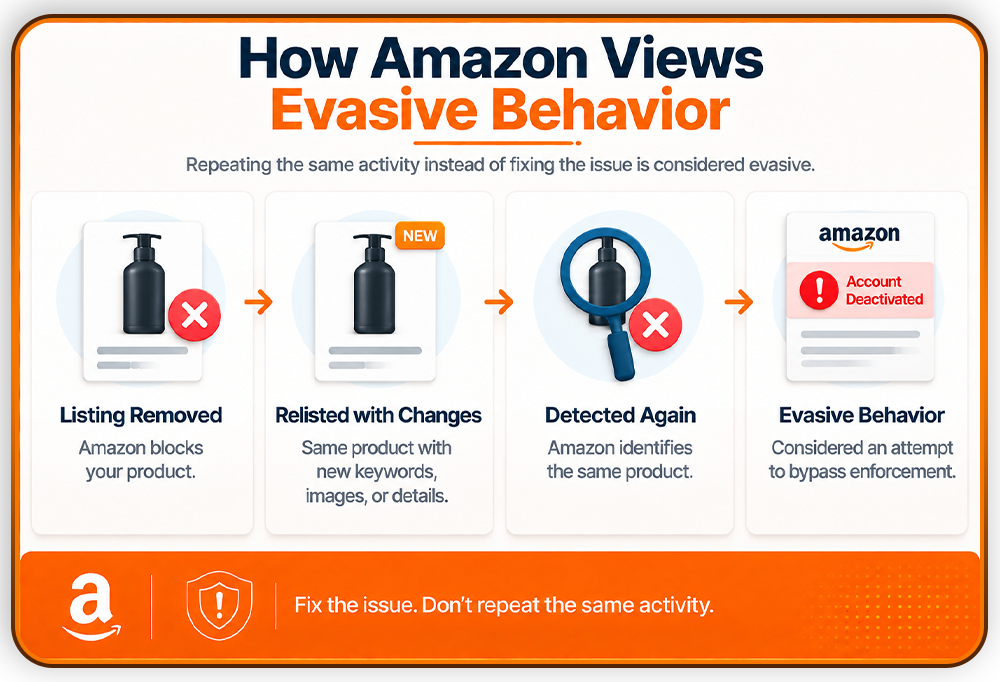
Amazon evasive behavior findings usually occur when a seller’s actions appear designed to bypass a previous enforcement decision instead of resolving the underlying issue. These cases often involve repeated attempts to continue the same activity after Amazon has already identified a compliance concern.
1. Relisting a Removed Product Without Fixing the Issue
One common example is relisting a removed or blocked product using new keywords, images, or descriptions without addressing the original reason for removal. Changing the appearance of a listing does not resolve the underlying compliance problem. If Amazon determines that the new listing represents the same product that was previously rejected, the action may be viewed as an attempt to avoid enforcement rather than a genuine correction.
2. Creating a New Seller Account After Suspension
Opening another seller account while an existing account is suspended is one of the most serious forms of account evasion. Amazon may evaluate connections between accounts using signals such as business information, payment details, tax information, devices, and account activity. Creating a new account before resolving the original suspension can create additional enforcement issues.
3. Making Only Cosmetic Listing Changes
Some sellers attempt to resolve listing restrictions by making surface-level changes, such as removing a keyword, updating a title, or replacing images. However, when the underlying problem involves product compliance, documentation, safety requirements, or restricted products, these changes may not address Amazon’s actual concern and can create the appearance of avoiding enforcement.
4. Using Another Account to Continue Selling
Amazon may also consider it evasive behavior when a seller continues restricted activity through another connected account. This can include using another person’s account, an employee’s account, or a related business account to continue selling products affected by enforcement actions.
5. Repeated Approval Attempts Without Corrections
Resubmitting the same product for approval multiple times without providing new documentation, addressing the rejection reason, or making meaningful product changes may be viewed as an attempt to bypass Amazon’s review process.
Why Amazon Reads Evasive Behavior as Intent Rather Than Error
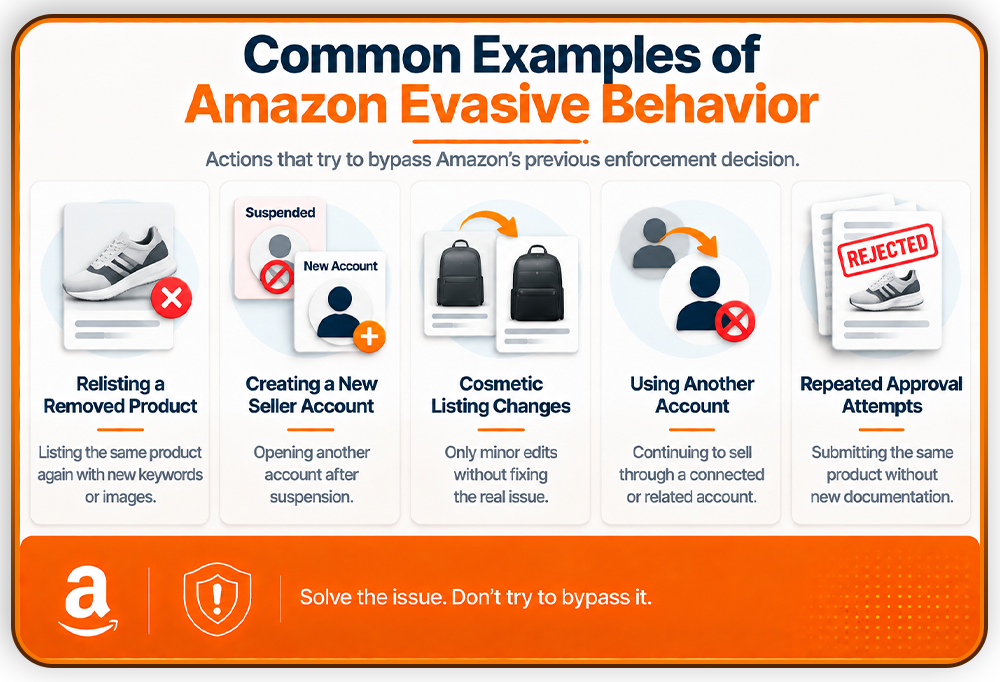
Amazon’s enforcement systems log every listing edit, every account creation timestamp, and every resubmission. When a seller takes the same rejected action twice with only cosmetic changes, that timeline is what a reviewer sees first, not the seller’s explanation of intent after the fact.
It is worth being honest here: Amazon has not published exact criteria for how many repeat attempts move a case from a routine rejected listing to a formal evasive behavior finding. What is consistent across seller reports is that it follows a pattern, not a single edit. Based on observed seller cases, one relisting attempt rarely triggers this label on its own. A second or third attempt, especially after an explicit rejection reason was already given, is where it tends to show up.
Why an Evasive Behavior Suspension Is the Hardest to Reverse
Compare it to other suspension types. A late shipment rate has a number you can bring back under a threshold. An inauthentic complaint has an invoice you can produce. An evasive behavior finding has neither. Amazon is not asking for a document here. It is making a judgment about intent, and intent is far harder to disprove than a missing number or a metric out of range.
Sellers and consultants who work these cases regularly describe evasive behavior findings as having no guaranteed reinstatement path unless the seller can show real proof of ongoing compliance, not just an explanation of what happened. That description matches the pattern visible in public seller forum threads: sellers who acknowledge the behavior and commit, in writing and with process changes, to full compliance review going forward tend to get further than sellers who argue the finding itself is a mistake.
It is worth staying skeptical of any article, including this one, that claims a specific reinstatement success rate for evasive behavior appeals. Amazon does not publish reinstatement data broken out by suspension category, so any number you see quoted elsewhere is an estimate, not a verified figure.
Can an Evasive Behavior Suspension Be Reversed?
Yes, but only when the seller can show Amazon that what looked like evasion was a genuine misunderstanding, not a deliberate workaround, backed by a corrected process going forward.
- Reinstatement is realistic when there is a real communication gap behind the relisting, for example, if the second listing went up before the seller ever received or understood Amazon's original rejection reason, and the seller has since removed the listing and put a review process in place.
- Reinstatement is far less likely when there is a documented pattern across multiple listings or multiple accounts, or the seller received an explicit warning and proceeded anyway.
There is no situation where reinstatement on an evasive behavior finding is guaranteed. Any appeal service or article that promises otherwise is not being straight with you, and setting that expectation clearly upfront matters more than sounding reassuring.
How to Appeal an Amazon Evasive Behavior Suspension
Step 1: Pull Every Piece of Your Own Timeline First
Before writing anything, gather your listing edit history, account creation dates if a second account is involved, and every case log tied to the original violation. Guessing at what triggered the evasive behavior finding, rather than confirming it from your own records, is one of the most common mistakes sellers make in a first appeal.
Step 2: Address the Original Violation and the Evasion Finding Separately
A Plan of Action that only fixes the restricted product or listing issue, without acknowledging why the relisting or reopening looked evasive to Amazon, tends to get denied. Both parts need their own explanation and their own evidence.
Step 3: Build a Plan of Action Around Root Cause, Action Taken, and Prevention
Use the same three-part structure Amazon expects across every account-level appeal: the root cause, corrective actions taken, and preventive measures. Our Plan of Action guide covers how to write each section so it holds up under review.
If the original flag traces back to a listing that was pulled down over an intellectual property complaint and then relisted, our IP complaint Plan of Action guide is the more specific resource for that root cause.
Step 4: Do Not Resubmit the Same Appeal With Minor Edits
A denied evasive behavior appeal that comes back lightly reworded reinforces exactly what Amazon already believes: that the seller repeats the same move rather than changing it. If a denial points to a specific gap, whether that is missing documentation or an unclear root cause, close that gap before resubmitting. Do not simply resend.
Amazon Evasive Behavior Reinstatement: What to Realistically Expect
There is no published timeline for this case type, and any article claiming a specific number of days for an evasive behavior review is guessing. What is consistent across seller reports is the shape of the process, not the speed of it.
The following can be the three outcomes after you resubmit:
- Reinstatement, when the evidence closes the specific gap Amazon flagged
- A request for more information, which usually means the case is still open but not yet convinced
- A final denial, which for an evasive behavior finding tends to carry more weight into any future review of related accounts tied to the same business
One detail worth knowing before you appeal: a final denial here does not just end the case for this account. Because evasive behavior findings are treated as evidence of pattern and intent, they can resurface if Amazon later reviews a different account connected to the same seller through shared business details, devices, or payment methods.
How to Avoid an Evasive Behavior Flag in the First Place
Preventing an evasive behavior suspension starts with showing Amazon that every action taken on your account is aimed at fixing compliance issues, not bypassing enforcement. Sellers should avoid making quick changes after a rejection or suspension and instead follow a documented process for resolving the underlying problem.
- Resolve Issues Before Relisting: If a listing is blocked or removed, do not recreate it with new keywords, images, or details. Address the original compliance issue first by submitting an appeal or contacting Seller Support for clarification.
- Avoid Creating New Accounts: If your account is suspended, do not open another seller account to continue selling. This can turn a recoverable suspension into a more serious related account or evasion issue.
- Maintain Account Separation: Keep clear separation between Amazon accounts connected to different businesses. Avoid sharing devices, payment methods, or account information when managing separate seller accounts.
- Document Listing Changes: Maintain records explaining why listing updates are made. A clear compliance history helps show Amazon that changes were made for correction purposes, not to avoid detection.
- Confirm Requirements Before Editing: If Amazon’s rejection reason is unclear, request clarification before making changes. Guessing and repeatedly modifying a listing can create a pattern that appears like an attempt to bypass enforcement.
Evidence Amazon Reviews During an Evasive Behavior Appeal
Because evasive behavior involves questions about intent, Amazon typically reviews the seller’s timeline and account history rather than only evaluating the current appeal.
A strong appeal should explain what happened before, during, and after the enforcement action. Supporting evidence may include:
- Seller Central case history and communication records
- Listing edit history and ASIN changes
- Product removal notices
- Supplier invoices and compliance documents
- Records showing corrective actions taken
The goal is to demonstrate that the seller addressed the original violation and did not intentionally attempt to bypass Amazon’s enforcement process.
Sellers should also explain the operational changes implemented to prevent similar issues in the future. This may include:
- New listing review procedures
- Compliance checklists before publishing products
- Employee training
- Documentation verification processes
Difference Between Evasive Behavior and Related Account Suspension
Although these issues often appear together, they focus on different concerns.
Evasive behavior relates to actions taken to bypass an enforcement decision, such as recreating a removed listing, changing product information to avoid detection, or continuing restricted activity after Amazon has already taken action.
Related account suspension focuses on connections between seller accounts. Amazon may investigate whether accounts share ownership, business information, payment methods, devices, or operational control.
In some cases, sellers may receive both types of enforcement when Amazon believes a connected account was used to continue activity restricted on another account. Our guide to Amazon linked account suspension explains how Amazon’s detection systems identify these connections, often between accounts that were never meant to be linked.
The Bottom Line
An evasive behavior suspension is hard to reverse because Amazon is judging a pattern of decisions, not a single fixable metric, and there is no guaranteed path back once that finding is on an account. The sellers who do get reinstated are usually the ones who stop treating it like a routine appeal and start treating it like what it actually is: a question about whether Amazon can trust the account going forward, not just whether one listing gets fixed.
Back to Selling’s reinstatement service reviews the case, separates the original violation from the evasion finding, and builds a Plan of Action aimed at both, rather than treating it like a standard suspension appeal. If you are dealing with an evasive behavior notice right now, getting the first appeal right matters more than getting it in fast.

Frequently Asked Questions
What is evasive behavior on Amazon?
Evasive behavior is Amazon’s term for taking deliberate steps to get around a suspension or listing block, such as relisting a blocked product with new details or opening a second account after enforcement. It is a finding attached to an existing violation, not a standalone policy.
Can an evasive behavior suspension be reversed?
It can be, but only when the seller can show the flagged action was a genuine misunderstanding rather than a deliberate workaround, backed by a Plan of Action that demonstrates real process change. There is no guaranteed path back.
Is evasive behavior always tied to a Section 3 violation?
Usually, yes. Evasive behavior is typically cited inside a Section 3 deactivation notice rather than as a standalone policy violation, since Amazon does not publish a separate evasive behavior policy page.
Does opening a new account count as evasive behavior?
Yes. Amazon treats a new account opened while another is suspended as both account evasion and a related account issue, which can put both accounts at risk.
How long does an evasive behavior appeal take?
There is no published timeline. Cases involving a clear pattern of repeated attempts tend to take longer and face more scrutiny than a first-time, low-severity flag.