
- admin
- Blog
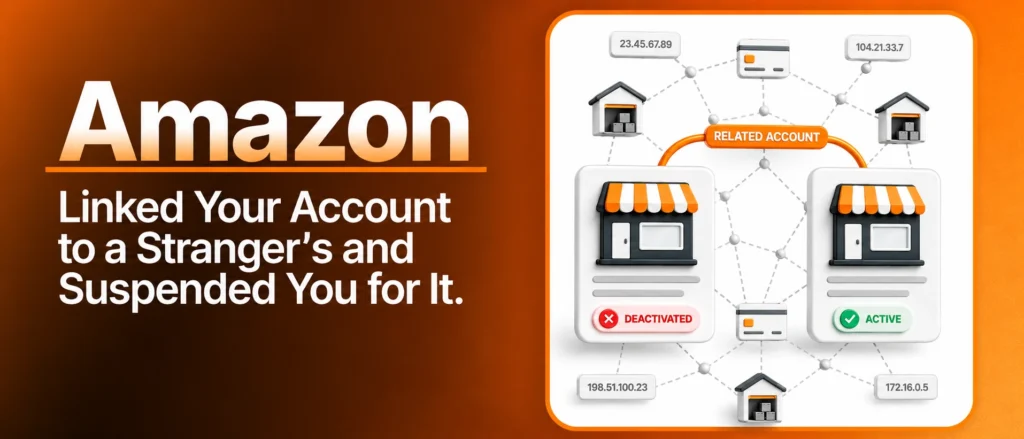
Amazon Linked Your Account to a Stranger's and Suspended You for It
You received an email saying your selling privileges are deactivated because your account is related to another seller account. You read the seller’s name and do not recognize it. You have never worked with this person, never met them, never heard of their brand. Your account has four years of clean history, a 98 percent on-time delivery rate, and zero policy violations. None of that mattered.
An Amazon-related account suspension is the only enforcement action where your own conduct is largely beside the point. Someone else’s problem became your problem because a machine found a data point you happen to share with them. Meanwhile, your FBA inventory sits frozen, your disbursements are held, and every day offline costs a seller doing $300K per month roughly $10,000 in lost revenue.
This post covers how the linkage forms, what to do in your first 48 hours, how to keep the business running while you appeal, and what to put in place so it never happens again.
Why Did Amazon Link My Account to Another Seller?
Amazon links seller accounts when its systems detect shared data points such as IP addresses, device fingerprints, bank details, tax IDs, business addresses, phone numbers, or third-party service providers. The link does not require intent or any actual relationship between the two sellers. A shared prep center, a virtual assistant who works for multiple clients, or a single login from a public network can trigger it.
How Does Amazon Detect Related Accounts?
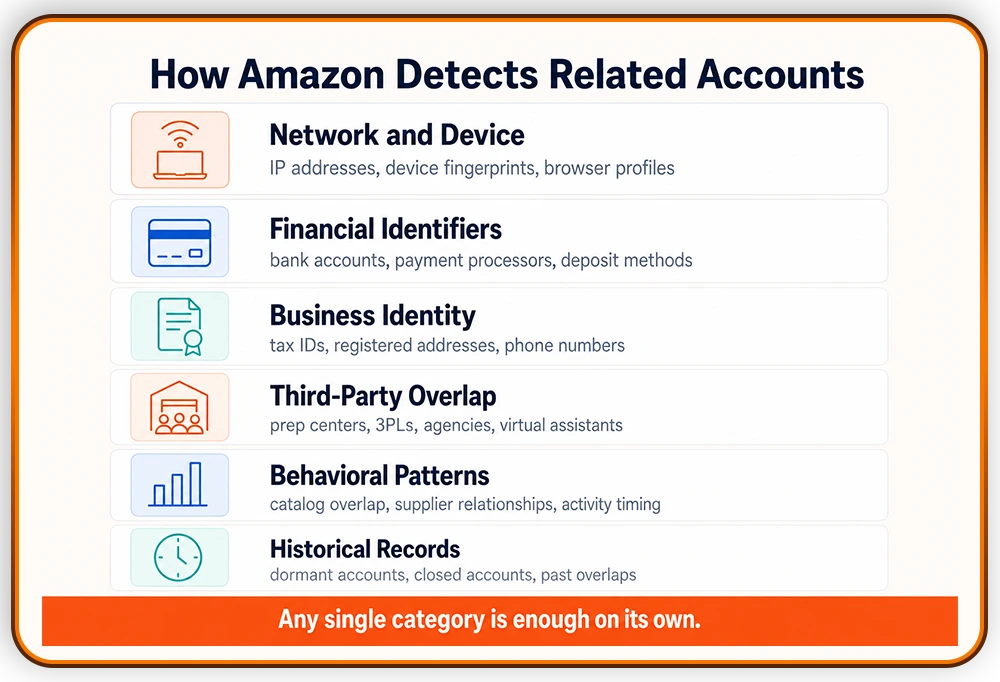
Almost every Amazon-related account suspension starts with a data point you never thought about. Amazon’s detection system looks across six categories of overlap, and any one of them can be enough on its own.
The Six Signal Categories
- Network and device signals: IP addresses, device fingerprints, browser profiles, cookies, and login environments.
- Financial identifiers: Bank accounts, credit cards, payment processors, and deposit methods.
- Business identity: Tax IDs, EINs, registered addresses, phone numbers, and email domains.
- Third-party overlap: Prep centers, 3PLs, agencies, virtual assistants, bookkeepers, and anyone else with account access.
- Behavioral patterns: Listing structure, catalog overlap, supplier relationships, and account activity timing.
- Historical records: Dormant accounts, closed accounts, and accounts from years ago sharing any of the above.
Why Innocent Sellers Get Amazon Linked Accounts Suspended?
Here is the part most articles skip. Amazon’s linkage system exists to catch ban evasion, and it is deliberately tuned to over-flag.
From Amazon’s position, missing a genuine evader who reopens under a new name costs far more than wrongly suspending a legitimate seller who can appeal. The system is not broken when it catches you by mistake. It is working as designed, and you are the acceptable cost.
That understanding changes how you write your appeal. You stop arguing that Amazon made an error and start proving the one fact that actually matters.
- Writing to convince, not to prove: An Amazon appeal built like a persuasive essay and one built to prove a specific fix are two different documents. Only one of them tends to survive Amazon's review process.
- Apologizing instead of showing the fix: Lines like "we value customer satisfaction" or "this won't happen again" don't carry much weight on their own, since Amazon isn't checking whether a seller feels sorry. It's looking for evidence that the actual mechanism behind the violation has been corrected
- Submitting before the root cause is confirmed: Guessing at the cause under pressure to respond quickly often means guessing wrong, and a confident-sounding guess still reads as a guess to a reviewer scanning for specifics. This one mistake alone tends to sit behind a large share of every Amazon seller appeal denied outcome that follows.
The Third-Party Overlap Nobody Audits
Most sellers know not to log in from a coffee shop. Far fewer have audited the vendors who log in on their behalf.
Consider what a typical setup looks like:
- Your prep center serves dozens of sellers from one warehouse address
- Your virtual assistant handles three other clients from the same laptop in the same city
- Your listing agency holds Seller Central credentials for forty accounts
- Your bookkeeper reconciles books for a dozen e-commerce brands from one office
Any one of those creates a shared data point. If a single client in that pool gets suspended, Amazon can pull the entire pool into the enforcement action.
The uncomfortable math is that vendor risk scales with vendor size. The prep center with two hundred clients has the best pricing and the most experience, and it is also the one most likely to have a suspended seller somewhere in its book. Sellers choose vendors on capability and cost. Almost nobody chooses on linkage exposure. Our guide on proactive measures to avoid Amazon account suspension covers the operational hygiene side in more depth.
The Amazon Account Linkage Policy Explained
Amazon’s policy prohibits operating multiple selling accounts without a legitimate business need or prior approval. Sellers read that and assume the violation is having two accounts. It is not.
What Amazon Is Actually Testing For
The Amazon account linkage policy targets one entity controlling two accounts. Shared infrastructure is treated as evidence of shared control, not as the violation itself.
That distinction reshapes your entire appeal strategy:
- The wrong argument: There is no connection between these accounts." This fails immediately when Amazon can point to a shared IP address.
- The right argument:"The connection exists and here is its innocent explanation, along with proof that ownership and control are entirely separate."
An appeal denying a provable fact reads as either dishonest or uninformed. An appeal that says “we share an IP block with our coworking space, here is the lease, here is the ISP letter, here is our separate banking, here is our sole ownership structure” addresses what Amazon is genuinely evaluating.
When an Amazon Multiple Account Suspension Is Justified
Not every linked account case is a false positive. Being honest with yourself here matters more than anything else you do.
An Amazon multiple account suspension is usually legitimate in three situations:
1. A previously enforced account reopened under new details. Amazon treats this as ban evasion and rarely forgives it.
2. Genuine shared ownership or management with a suspended party. The relationship exists whether or not you ever formalized it on paper.
3. A dissolved partnership never reported to Amazon. Old credentials, addresses, or banking information stay attached to your profile long after the partner leaves.
If any of those describe your situation, denial is the worst available move. Amazon can prove facts you cannot disprove, and a false denial in writing follows the case permanently.
The Legitimate Business Need Exception
Amazon does permit multiple accounts with prior approval when a legitimate business need exists. Qualifying scenarios typically include genuinely distinct product lines operating as separate legal entities, or a manufacturer selling through a separate brand.
The critical detail is timing. Approval must be granted before the second account exists. Amazon does not grant it retroactively once a suspension has already been issued.
Account Suspended Due to Linked Account That Isn't Mine: Your First 48 Hours
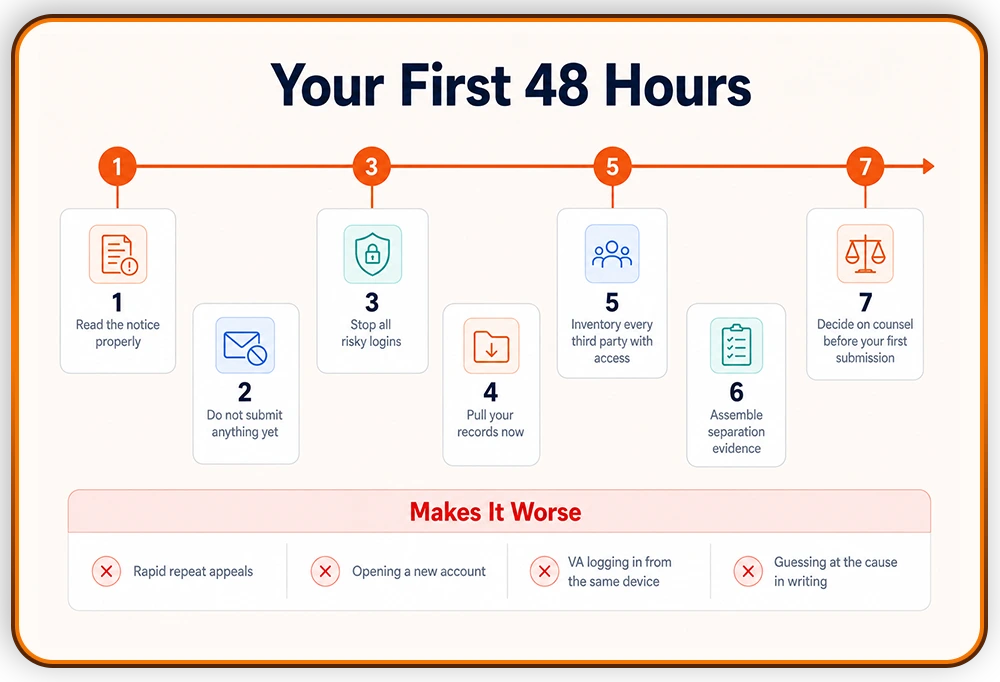
The instinct after an Amazon-related account suspension is to appeal immediately. Resist it. Your first submission frames every review that follows, and a rushed appeal usually locks in a rejection you then spend months trying to unwind.
The Seven-Step Sequence
1. Read the notice properly. Identify the exact policy section cited and note any seller name, storefront, or merchant ID Amazon provides. Some notices name the linked party and some do not.
2. Do not submit anything yet. Nothing you send in the first few hours will beat what you can send in 48.
3. Stop all risky logins. No public networks, no shared devices, no VA access until you know what caused the flag.
4. Pull your records now. Download login history, user permissions with dates, and account information while you still have visibility.
5. Inventory every third party with access. Current and historical. Prep centers, agencies, VAs, freelancers, consultants, accountants, anyone who ever held credentials.
6. Assemble separation evidence. Entity documents, banking, lease, ISP records, device list, ownership declaration.
7. Decide on counsel before your first submission, not after your third rejection.
The Actions That Make It Worse
Several common responses actively damage the case:
- Submitting multiple appeals in quick succession. This signals panic and clogs your own case file.
- Opening a new account. This converts a recoverable suspension into a permanent ban with no realistic path back.
- Letting your VA log in from the same environment. You are reinforcing the exact pattern Amazon flagged.
- Writing an emotional or accusatory appeal. Reviewers deprioritize these.
- Guessing at the cause in writing. This is the most common and most damaging error.
That last one deserves expansion. Sellers often speculate about the cause in their first appeal, name a possible source, then discover the real trigger was something else entirely. Now the file contains a theory that contradicts the evidence, and every later appeal has to explain the inconsistency.
Business Continuity During an Amazon Suspension
Almost every article about an Amazon-related account suspension ends at the appeal. That leaves out the part determining whether your business is still standing when reinstatement arrives.
Protecting Your Inventory and Funds
- FBA inventory: Your stock stays in Amazon’s network and remains unsellable. Do not reflexively submit removal orders. Inventory movement during an active related account review can read as an attempt to shift stock toward another account, which is precisely the behavior Amazon suspects. Decide on removals deliberately and document the reasoning.
- Held funds: When linked accounts are suspended together, disbursements stop across all of them at once, including accounts with spotless histories. Amazon holds funds through the review period and often past it. For a seller running 30-day inventory cycles, this is usually more dangerous than the lost sales.
Managing Cash, Staff, and Suppliers
- Run the cash arithmetic honestly: A $300K per month seller facing a 60-day suspension is looking at roughly $600K in unrealized revenue plus held disbursements, while payroll, software, warehousing, and loan payments continue. Whatever reserve you built for Q4 inventory is now your survival runway.
- Pause advertising fully: Do not simply lower budgets, and record the pause date. Partial spend on deactivated listings burns cash for nothing.
- Contact suppliers immediately: Any manufacturer with a purchase order in production needs to hear from you early. A supplier contacted in week one will usually renegotiate timing. A supplier who hears nothing for six weeks will tighten your terms permanently.
Why a Second Channel Changes the Math
This is where a Shopify store stops being a nice-to-have. Sellers with an established direct channel keep some revenue moving, keep their team busy, and keep supplier relationships intact through a suspension.
Be realistic about timing, though. A store launched during a suspension will not replace Amazon revenue in any useful timeframe, since traffic takes months to build. This is a prevention argument rather than a rescue plan. Our Shopify store management services exist partly for this reason, and our guide to Amazon account health metrics that matter covers the monitoring that catches problems earlier.
Amazon Linked Account Suspension: How Long Does Reinstatement Take?
Amazon publishes no service level agreement for related account reviews, and any article quoting a firm number is guessing. What can be described honestly is the shape of the process.
The Four Stages
1. Initial review: Follows your first appeal and is the fastest stage, though “fast” here means days rather than hours. Most related account cases are not resolved here.
2. Multiple appeal rounds: These are the norm, not the exception. Public Seller Central forum threads routinely show sellers on their third or fourth submission before getting traction. Sellers who eventually succeed usually do so because each appeal added new documentary evidence, not because they resubmitted the same argument reworded.
3. Video or identity verification: May be requested, which adds scheduling time. This is generally a positive signal, since it means a human is now involved.
4. Funds release: Runs on its own clock and does not release when your listings do. Plan cash flow assuming money stays held longer than selling privileges stay suspended.
5. Inventory every third party with access. Current and historical. Prep centers, agencies, VAs, freelancers, consultants, accountants, anyone who ever held credentials.
6. Assemble separation evidence. Entity documents, banking, lease, ISP records, device list, ownership declaration.
7. Decide on counsel before your first submission, not after your third rejection.
The Escalation Ladder
When standard appeals stop producing movement, a defined sequence exists beyond Seller Performance:
- Executive Seller Relations: Handles escalated cases and reviews with more discretion than the standard queue.
- BBB complaint: Typically, routes to a human reviewer in a different workflow, which is why practitioners use it when automated rejections repeat.
- Arbitration under the Business Solutions Agreement: As a final avenue, this is a legal proceeding rather than an appeal, so it belongs with counsel and not with a DIY submission.
The signal to escalate is repetition. If you receive substantially the same rejection language twice despite submitting new evidence, additional standard appeals are unlikely to change the outcome. At that stage, the dispute is less about the Amazon account linkage policy itself and more about getting a human to read your file.
The Separation File Every Seller Should Have Ready
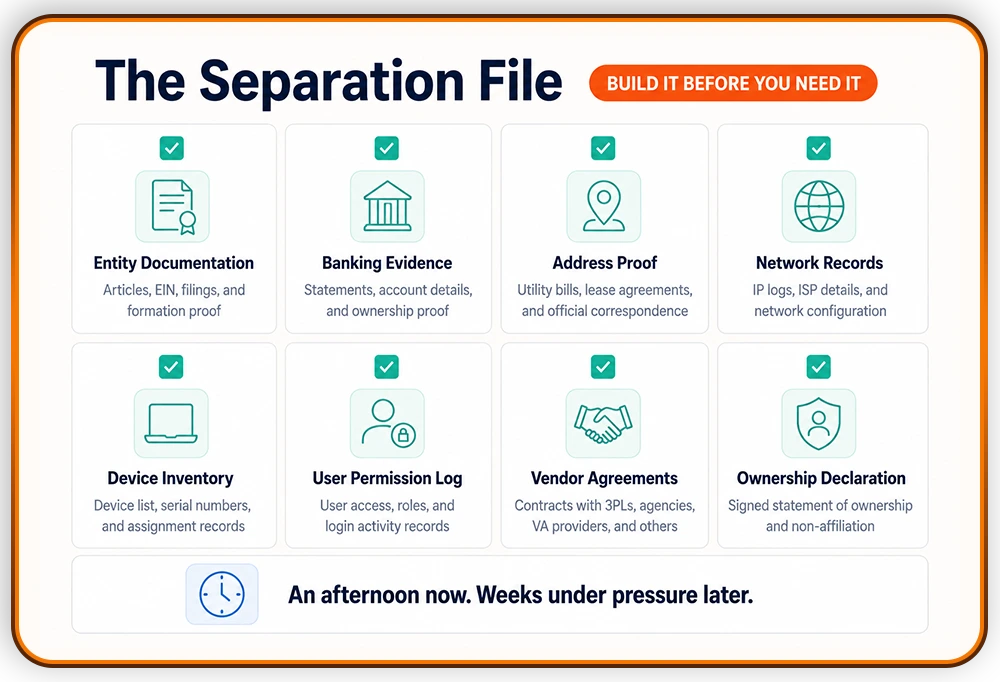
Everything above assumes an Amazon-related account suspension has already landed. This section is for the reader who has not been hit yet, and it is the highest-value thing in this post.
What Goes in the File
Build it now, while it is easy and free, and store it outside Seller Central:
- Entity documentation: Articles of incorporation, operating agreement, EIN letter, business license
- Banking evidence:Statements showing an account used solely by this entity, with no overlap into other businesses
- Address proof: Lease or deed, utility bills, and written confirmation of any 3PL or coworking arrangement
- Network records: ISP documentation of your static IP, plus a written list of every location you log in from
- Device inventory: Which machines access Seller Central, who controls them, and where they physically live
- User permission log: Every person granted access, their role, dates granted and revoked, screenshotted at the time
- Vendor agreements: Signed contracts with data separation and exclusivity terms where possible.
- Ownership declaration: A dated statement of who owns and controls the account, refreshed annually
Assembling this after a suspension takes weeks under pressure, and some records get harder to obtain once account access is restricted. Assembling it on a quiet Tuesday takes an afternoon.
The Five Vendor Questions to Ask Before You Sign
Vetting for linkage risk requires specific questions, not a general sense that a vendor seems professional. Ask every prep center, agency, and VA:
1. How many other Amazon sellers do you currently serve?
2. Has any client of yours been suspended in the past 24 months, and for what reason?
3. Do you use a dedicated IP address and device profile per client, or a shared environment?
4. Will you sign a data separation clause in our agreement?
5. Which named individuals will hold our Seller Central credentials, and how is access revoked when they leave?
A good answer is specific and slightly uncomfortable to give. A bad answer is reassurance without detail, defensiveness about the question itself, or a claim that linkage risk is not a real concern. Vendors who take account security seriously will have ready answers, because their better clients have asked before.
When to Hire Counsel Instead of an Agency
Some situations need a lawyer, and pretending otherwise would not serve you.
Hire Counsel When
- You genuinely own or previously owned a linked account
- A former business partner is involved
- Amazon requests an affidavit
- Appeals have been rejected more than twice
- Arbitration is under consideration
- Funds and inventory at stake exceed legal costs by a comfortable margin
At $200K to $500K per month, that last threshold is crossed almost immediately.
An account management agency handles prevention, account health monitoring, and operational continuity through a suspension. It does not replace legal representation on a Section 3 enforcement matter, and any agency claiming otherwise is acting beyond its competence. If you are weighing what ongoing support costs, our breakdown of Amazon account management cost gives real numbers.
The Bottom Line
A related account suspension can be difficult to control once Amazon identifies a connection between seller accounts. The best defense is preparation: vet vendors for potential account-linkage risks, maintain a clean login and operating environment, keep clear documentation proving account separation, and build additional sales channels so one enforcement action does not bring your entire business to a standstill.
Back to Selling’s Amazon Reinstatement Service helps you navigate account suspensions with a structured, evidence-based approach. We assess the reason for the suspension, identify the underlying issues, build a detailed Plan of Action, and guide you through the reinstatement process. For complex cases where legal intervention may be necessary, we’ll tell you when involving an attorney is the right next step.

Frequently Asked Questions
Why did Amazon link my account to another seller I have never met?
Amazon links accounts based on shared data points rather than proven relationships. A shared IP address from a public network, a prep center or 3PL serving both of you, a virtual assistant with multiple clients, or an overlapping business address can all create the link. No contact between the two sellers is required.
My account was suspended for an alleged link to another account, and I need help. Where do I start?
Start by reading the notice for the specific policy cited and any seller identity given. Do not appeal in the first hours. Pull your login history and user permission records, inventory every third party who has ever had account access, and assemble your separation documentation. Your first appeal frames the entire case, so prepare it properly before submitting.
Does Amazon review every appeal manually?
Amazon uses a mix of automated screening and human review, with a heavy volume of daily submissions processed against standardized criteria rather than read individually start to finish. This is exactly why an Amazon appeal written to be scanned for specific elements performs better than one written to be read start to finish like a letter.
How long does an Amazon-related account suspension last?
Amazon publishes no guaranteed timeline. Multiple appeal rounds are common, with each round adding weeks, and cases involving genuine documentation gaps run considerably longer than clear false positives. Funds hold operate on a separate schedule and frequently outlast the suspension itself, so plan cash flow assuming money stays held after listings return.
Can Amazon suspend my account because of a stranger?
Yes, a related account suspension issue on Amazon does not require any relationship between the two sellers. Shared infrastructure alone is sufficient, which is why sellers get suspended over coworking spaces, shared prep centers, and vendors they never knew served a suspended competitor.
Should I open a new account while I appeal?
No. Opening a new account during an active suspension is treated as ban evasion and turns a recoverable case into an Amazon multiple account suspension with essentially no path back. It also puts any other account you touch at risk of the same enforcement.
One Response