
- Affan Waseem
- Blog
Amazon 365-Day Invoice Rule for Counterfeit Appeals What Sellers Need to Submit
An Amazon authenticity or counterfeit complaint can put your listings at risk and require you to prove that your inventory came from a legitimate source. When Amazon requests supplier invoices, many appeals fail because the submitted documents are outdated, incomplete, or cannot be verified.
Amazon requires sellers to provide valid purchase documentation that supports the authenticity and sourcing of their products. For many authenticity-related reviews, invoices must fall within the previous 365 days and include enough information for Amazon to verify the supplier, products, and purchase history.
However, submitting a recent invoice alone does not guarantee reinstatement. Amazon also evaluates whether the supplier is legitimate, whether the documentation is authentic, and whether the invoice information matches the inventory connected to the complaint.
This guide explains Amazon’s 365-day invoice requirement, what information invoices need to include, how authenticity and counterfeit complaints differ, and what sellers can do when their documentation does not meet Amazon’s requirements.
What Is Amazon's 365-Day Invoice Requirement?
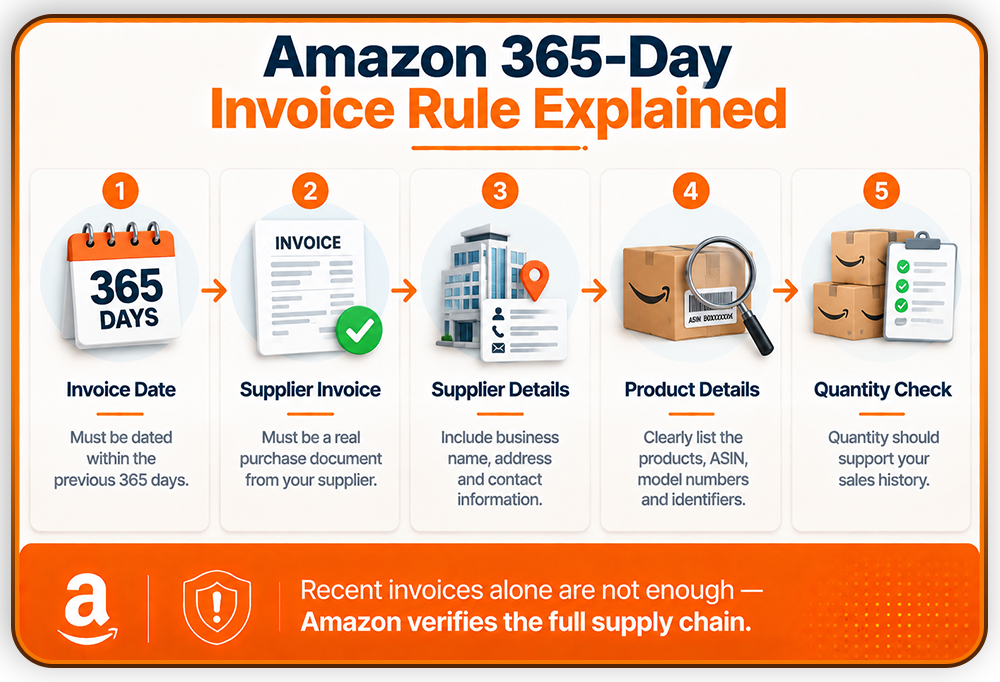
When Amazon reviews an authenticity or counterfeit-related complaint, sellers may be required to submit supplier invoices as evidence of their inventory source.
A key requirement is that invoices must generally be dated within the previous 365 days. Amazon uses the invoice date to determine whether the document falls within the acceptable timeframe. The date a product was listed, received into inventory, or sold does not extend the validity period.
For example, if a seller submits an appeal in September 2026, an invoice dated before September 2025 may fall outside Amazon’s required timeframe.
The invoice also needs to demonstrate a legitimate supply chain connection. Amazon reviews whether the document identifies a real supplier, clearly describes the products purchased, and provides enough information to connect the inventory to the affected listing.
A recent invoice from an unverifiable supplier may not support an appeal, while a complete invoice from a legitimate supplier provides stronger evidence of product sourcing.
Counterfeit Complaint vs. Authenticity Complaint: What Is the Difference?
Amazon sellers often use the terms authenticity complaint and counterfeit complaint interchangeably, but they address different issues.
An authenticity (inauthentic) complaint questions whether a seller can prove the legitimate source and supply chain of a product. Amazon is primarily looking for evidence that the inventory was purchased through a reliable and verifiable source.
A counterfeit complaint is a more serious intellectual property allegation claiming that a seller offered an unauthorized or fake version of a branded product. These complaints often involve concerns raised by a rights owner or brand protection system.
Understanding the difference helps sellers prepare the right type of response.
Authenticity Complaints
Authenticity complaints are mainly focused on sourcing documentation. Amazon wants to understand where the product came from and whether the seller can prove that the inventory was obtained through a legitimate supply chain.
These complaints may occur because of customer reports, product condition concerns, packaging issues, or Amazon’s internal authenticity review processes.
A successful response usually focuses on:
- Valid supplier invoices
- Supplier verification
- Product identification
- Purchase history
- Inventory documentation
Counterfeit Complaints
Counterfeit complaints involve intellectual property concerns and usually require sellers to address whether the product is an authorized genuine item.
In addition to invoices, sellers may need supporting evidence such as authorization documents, distributor information, or communication with the rights owner.
While invoices remain important in both situations, the appeal strategy depends on the reason Amazon removed the listing.
What Information Must Amazon Appeal Invoices Include?
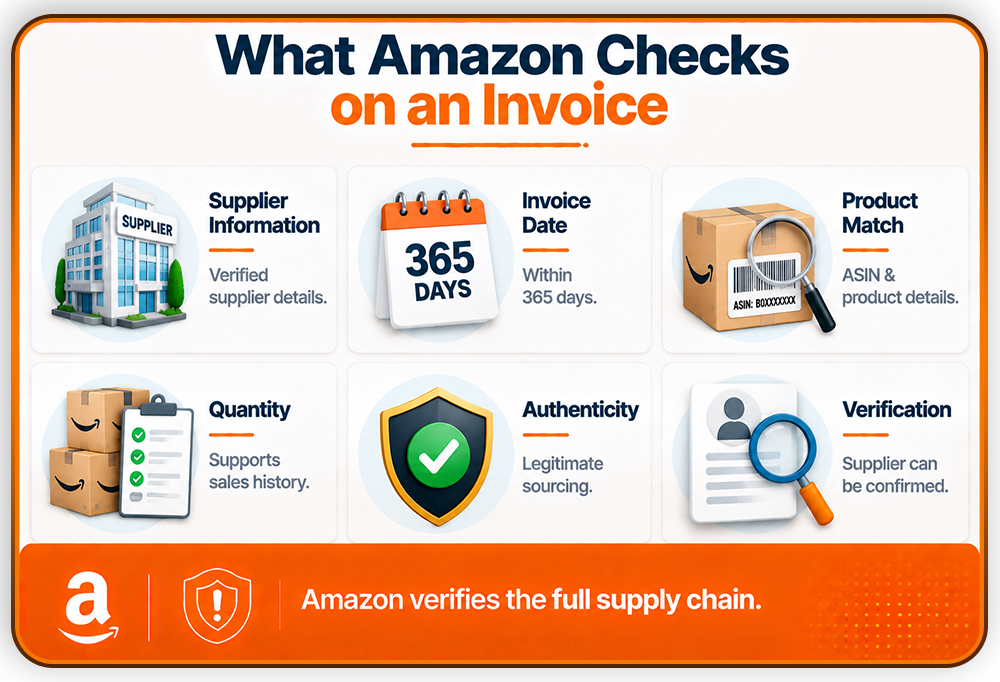
A valid invoice is not only about meeting the 365-day timeframe. Amazon also evaluates whether the document provides enough information to verify the transaction and connect the inventory to the affected product.
1. Supplier and Buyer Information
The invoice should clearly identify the supplier that sold the products. This typically includes the supplier’s business name, address, and contact information such as a phone number, email address, or website.
Your own business information should also match your Seller Central account details. Differences between your registered business information and invoice details can create additional questions during review.
2. Product Details
The invoice should clearly identify the products involved in the complaint. Product descriptions, model numbers, UPCs, EANs, or other identifiers help Amazon match the purchased inventory to the affected ASIN.
A generic invoice description that does not clearly identify the product may not provide enough evidence for Amazon to verify authenticity.
3. Quantity and Purchase History
The invoice quantity should reasonably support the inventory you sold. Amazon may compare the units purchased against your sales history, inventory records, and FBA activity.
For example, if a seller has sold hundreds of units but submits an invoice showing only a small purchase quantity, Amazon may question whether the documentation covers the affected inventory.
4. Genuine Purchase Documentation
Amazon expects authentic purchase invoices from legitimate suppliers. Documents such as quotes, pro forma invoices, order confirmations, or packing slips generally do not provide the same level of verification as a completed supplier invoice.
Before submitting an appeal, sellers should ensure that all documents are original, readable, and unchanged
What If Your Invoices Are Older Than 365 Days?
One of the most common challenges sellers face during an Amazon authenticity or counterfeit appeal is discovering that their available invoices fall outside the required timeframe. Amazon generally requires invoices to meet its documentation requirements, including the applicable invoice date window. An explanation that the inventory was purchased in bulk, stored for a long period, or is still authentic does not replace the need for valid supporting documentation.
Instead of relying only on an explanation, sellers should focus on obtaining stronger supporting evidence.
Request Additional Genuine Invoices From Your Supplier
The first step is to contact your supplier and request any other genuine invoices related to the affected products.
A supplier may have issued multiple invoices for:
- Additional purchases
- Partial shipments
- Reorders
- Different purchase dates for the same product
Only use invoices that represent real transactions. Asking a supplier to change dates, quantities, or product details creates inaccurate documentation and can create additional account risks.
Purchase Again From the Same Supplier When Appropriate
In some situations, placing a new order with the same legitimate supplier can provide a current invoice that falls within Amazon’s required timeframe.
However, a new purchase does not automatically prove that all previously sold inventory came from that transaction. Sellers should use the new invoice together with other available records to explain their sourcing history clearly.
The goal is to demonstrate a consistent and legitimate supply chain, not simply provide a recently dated document.
Work With the Rights Owner When Applicable
For counterfeit complaints involving a brand owner, contacting the rights owner may be another option. If the rights owner confirms that the products are authentic or withdraws the complaint, this information may support your case. However, rights owners are not required to retract complaints, and sellers should not rely on this as the only resolution path.
Add Supporting Supplier Documentation
A supplier letter can provide additional context about the business relationship, product sourcing, or distribution arrangement.
However, a supporting letter does not replace a valid purchase invoice. Amazon primarily relies on verifiable purchase documentation when reviewing authenticity-related concerns.
Can You Use Distributor Invoices Instead of Brand Invoices?
Many sellers source products through distributors rather than purchasing directly from the brand. In these cases, distributor invoices may be acceptable if the supplier is legitimate and the supply chain can be verified.
A distributor invoice should clearly show the transaction details, including the supplier information, purchased products, quantities, and dates.
The stronger the connection between the distributor and the brand, the easier it is to demonstrate that the products entered the supply chain through an authorized source.
When submitting distributor invoices, sellers should review whether additional documentation is needed, such as:
- Proof that the distributor is authorized
- Distributor website and contact information
- Authorization documents from the brand
- Additional purchase history
A distributor invoice from an unverifiable source can create the same problems as an incomplete supplier invoice.
Common Reasons Amazon Rejects Invoice-Based Appeals
Amazon invoice appeals are often rejected because the documents do not fully answer the questions behind the complaint: Where did the inventory come from, who supplied it, and can the transaction be verified?
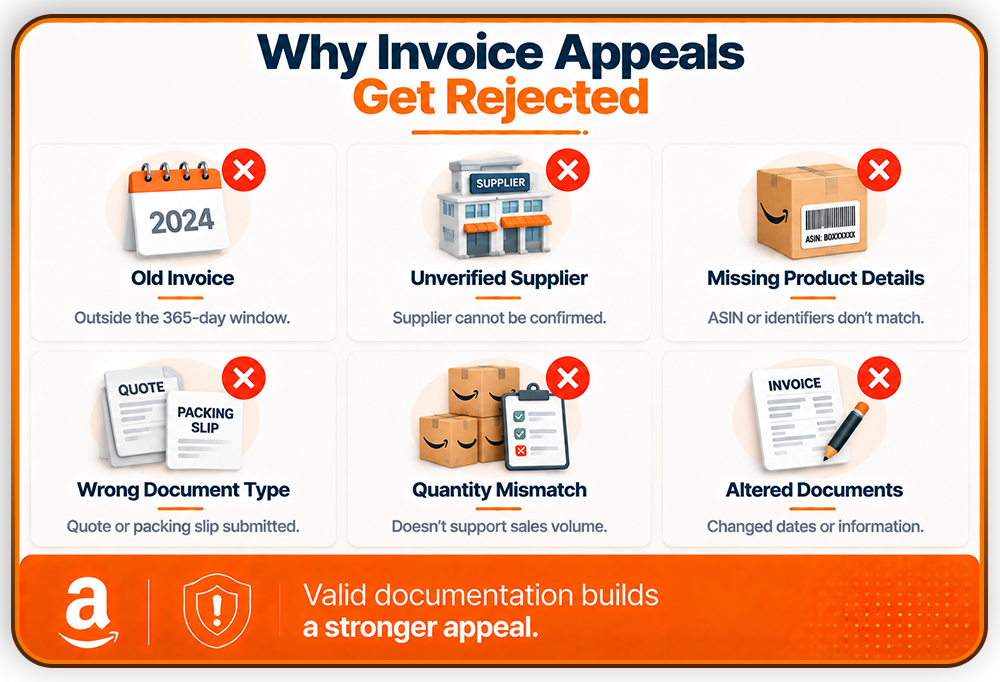
- Invoice Outside the Required Timeframe: The invoice date is one of the first details Amazon reviews. Documents outside the required timeframe may not be considered valid evidence for the appeal.
- Supplier Cannot Be Verified: Even a recent invoice may fail if Amazon cannot confirm that the supplier is a legitimate business. Before submitting an appeal, verify that your supplier has:
- Real business contact information
- A functioning website or business presence
- A verifiable relationship to the products being sold
- Product Information Does Not Match: Invoices should clearly connect to the affected product. Missing model numbers, unclear descriptions, or incomplete identifiers can make it difficult for Amazon to verify the inventory.
- Quantity Does Not Support Sales: If your sales volume is significantly higher than the quantity shown on your invoices, Amazon may question whether the documents cover the inventory involved in the complaint.
- Incorrect Document Type: Purchase invoices should not be replaced with documents that do not prove a completed transaction, such as:
- Quotes
- Order confirmations
- Packing slips
- Pro forma invoices
-
- Documents Appear Altered: Amazon requires authentic documentation. Edited files, changed dates, modified quantities, or altered supplier information can create serious problems beyond the original complaint.
It’s important to resolve product authenticity issues, because repeated authenticity issues that stay unresolved can put the whole account at risk. Our guide to Section 3 account violations explains how that escalation works.
How to Maintain 365-Day Invoice Coverage Before an Amazon Appeal
The best time to prepare invoice documentation is before Amazon sends an authenticity or counterfeit complaint. Many sellers only review their invoices after a listing is removed, but by that point, missing documents or outdated purchase records can make the appeal process much harder.
Maintaining organized supplier records helps you respond faster and ensures that your documentation is ready if Amazon requests proof of sourcing.
1. Organize Invoices by Product
Keep invoices organized by ASIN, SKU, or product category instead of storing documents in one general folder. A structured system makes it easier to quickly identify:
- Which supplier provided the inventory
- When the product was purchased
- How many units were purchased
- Which listings the invoice supports
When Amazon requests documentation, being able to locate the correct invoice immediately can save valuable time during the appeal process.
2. Review Invoice Age Regularly
Invoice coverage should be reviewed before an issue occurs. Sellers should periodically check whether their available invoices are approaching the 365-day window, especially for products that continue selling over long periods.
For products with ongoing sales, maintaining recent purchase records can prevent situations where the only available documentation is too old to support an appeal.
3. Maintain Supplier Documentation
Invoices should not be the only record you keep. Maintain additional supplier information, including:
- Supplier contact details
- Distributor information
- Authorization documents where applicable
- Purchase history
A complete supplier record creates a clearer picture of your supply chain if Amazon reviews your account.
4. Verify Suppliers Before Purchasing
Strong invoice documentation starts with choosing reliable suppliers. Before purchasing inventory, verify that the supplier is a legitimate business and that they can provide proper commercial invoices. Buying from unknown sources or suppliers who cannot provide complete documentation creates risk if Amazon later requests proof of authenticity. Confirm that the supplier is the brand or an authorized distributor. Our guide to Amazon restricted products explains how to check category and brand requirements before sourcing.
Getting Back to Selling
Amazon authenticity and counterfeit appeals depend on proving that your products come from a legitimate and verifiable supply chain. A recent invoice is important, but successful appeals require more than just uploading a document.
The strongest appeals connect supplier invoices, product information, purchase history, and corrective actions into a clear explanation that addresses Amazon’s concerns.
If your appeal was rejected or you are unsure whether your documentation meets Amazon’s requirements, Back to Selling can review your invoices, identify documentation gaps, and help build an appeal strategy based on the evidence available.

Frequently Asked Questions
What invoices does Amazon require for a counterfeit appeal?
Amazon requires real purchase invoices from your supplier, dated within 365 days, that show the supplier’s and your contact details, a clear product description with identifiers, and quantities that cover your sales. Quotes and pro forma invoices are generally rejected.
How far back do Amazon invoices need to go?
Invoices need to be dated within the last 365 days, and sellers count this from the day they submit. Amazon staff have said that an invoice dated outside this window is not valid and is rejected.
Can I use invoices older than 365 days?
Amazon’s stated position is no. Some sellers report exceptions, but Amazon has not documented any. The safer approach is to get a new invoice through a new purchase or to find other genuine invoices from your supplier that fall within the window.
Can I submit a receipt or pro forma invoice instead?
Consultancies report that pro forma invoices, quotes, order confirmations, and packing slips are rejected. Submit a completed purchase invoice from your supplier.
Does the invoice quantity have to match my sales?
The invoice quantity should cover the units you sold over the same period. Sellers and consultancies describe the rule as units sold being equal to or lower than units invoiced, and a quantity mismatch is a common reason for rejection.