
- admin
- Blog
Your Appeal Was Rejected Because It Was Written for a Human. Amazon's System Isn't.
You wrote something honest. You explained what happened, you apologized where it made sense, you probably spent hours getting the tone right. And Amazon rejected it anyway, in what felt like minutes.
That rejection wasn’t about your writing quality or your sincerity. It happened because you wrote an Amazon appeal the way you’d write a letter to a person, and Amazon doesn’t review Amazon appeals the way a person reads a letter. It reviews them the way a system checks a form, scanning for specific elements, and if those elements aren’t there in a way it can immediately recognize, the appeal gets rejected regardless of how true or well-written it is.
What Does Amazon's Appeal Review System Actually Look For?
Amazon receives thousands of appeal submissions every single day, reviewed by a global team working under real-time pressure and specific, standard guidelines. Nobody is sitting down to slowly read your whole story. Reviewers are trained to scan for particular elements, and if your submission doesn’t hit those elements clearly and fast, it gets rejected, even when every fact in it is true.
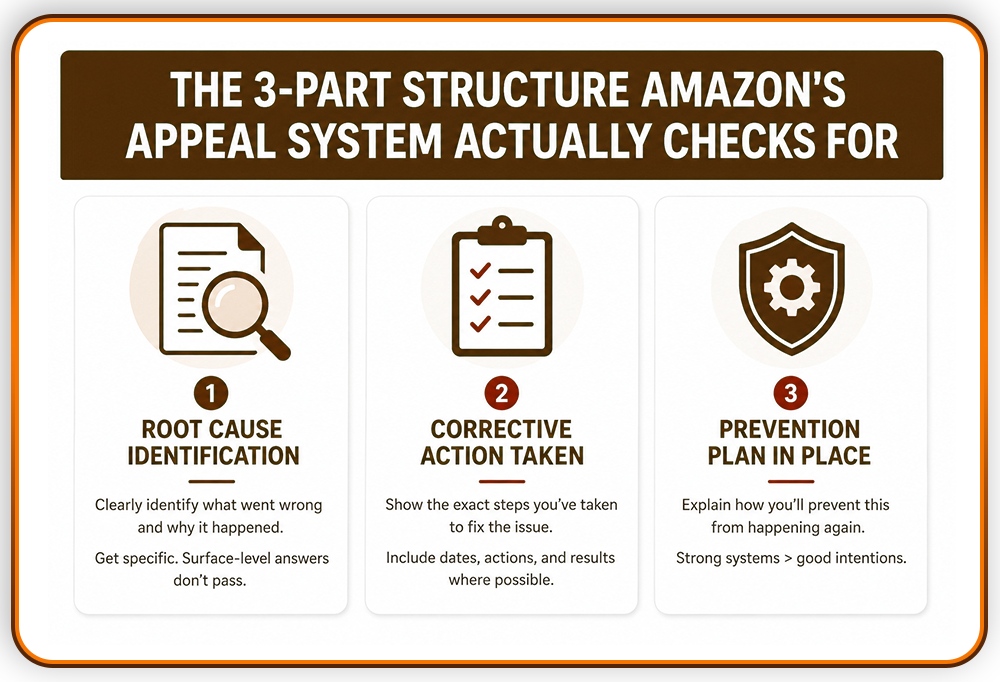
The elements they’re trained to look for come down to three things, in this order:
- Root cause: what actually caused the violation, stated plainly, not implied
- Corrective action: what you already did to fix it, with proof attached
- Prevention: what specifically stops it from happening again, described as a real process, not a promise
This is the structure known as a Plan of Action, and it’s less a persuasive letter than it is an evidence document. Amazon’s underlying question when reviewing any Amazon suspension appeal isn’t “does this seller feel bad,” it’s “does reinstating this account protect or threaten customer trust?” Every part of the review filters through that one lens. An appeal that’s emotionally compelling but doesn’t answer that question directly gets rejected just as fast as one with no emotion at all. Understanding this is really the whole foundation of a working Amazon appeal process, before a single word gets written.
What Are the Real Reasons Amazon Appeals Get Rejected?
Once you understand what the system is actually scanning for, the Amazon appeal rejection reasons stop feeling random. Most Amazon appeals fail for five repeat reasons: wrong root cause, defensive tone, unverifiable documents, generic templates, or resubmitting unchanged. Reviewers scan for verifiable proof, not a persuasive story. Getting the root cause right usually prevents the rest.
- The Plan of Action addresses the wrong root cause: This is the single most common reason Amazon appeals fail. Sellers often assume they know what triggered the violation when the actual trigger was something else entirely, and an appeal that answers the wrong problem gets dismissed as off-topic no matter how well it's written. Getting this wrong once and resubmitting the same guess a second time just repeats the failure.
- The tone reads as defensive: Appeals that blame the customer, blame Amazon, or minimize the violation get rejected even when the underlying facts are on the seller's side. Amazon is looking for accountability, not an argument. The moment an Amazon appeal starts explaining why the rule shouldn't have applied, it stops being useful to the reviewer scanning it.
- The documentation is missing or can't be verified: If Amazon asks for invoices and the invoices don't match in supplier name, date, or quantity, the appeal fails on a technicality that has nothing to do with whether the seller is telling the truth. An Amazon seller appeal denied for this reason is one of the most fixable failures on this whole list, and also one of the most common.
- The appeal reads like a generic template: Amazon can tell the difference between an Amazon appeal written for this specific violation and one copied from a template found online. A performance suspension needs an operational fix described in detail. An authenticity suspension needs invoices. A multiple-account flag needs technical separation evidence. Template language rarely answers any of these specifically enough to pass.
- The same appeal gets resubmitted with no real changes: Resubmitting an unchanged Plan of Action after a rejection doesn't just fail again; it actively signals to Amazon that the underlying problem hasn't been addressed, which makes the next Amazon suspension appeal harder to win, not easier. Every rejected appeal becomes part of the account's history, and a pattern of repeated, unchanged submissions reads as unreliability rather than persistence.
What Mistakes Keep Amazon Reinstatement Appeals Stuck?
A smaller set of Amazon reinstatement appeal mistakes sits underneath those five patterns, causing them in the first place. These are worth naming directly, since they’re the ones sellers tend to repeat without realizing it.
- Writing to convince, not to prove: An Amazon appeal built like a persuasive essay and one built to prove a specific fix are two different documents. Only one of them tends to survive Amazon's review process.
- Apologizing instead of showing the fix: Lines like "we value customer satisfaction" or "this won't happen again" don't carry much weight on their own, since Amazon isn't checking whether a seller feels sorry. It's looking for evidence that the actual mechanism behind the violation has been corrected
- Submitting before the root cause is confirmed: Guessing at the cause under pressure to respond quickly often means guessing wrong, and a confident-sounding guess still reads as a guess to a reviewer scanning for specifics. This one mistake alone tends to sit behind a large share of every Amazon seller appeal denied outcome that follows.
What Happens If Your Appeal Is Denied?
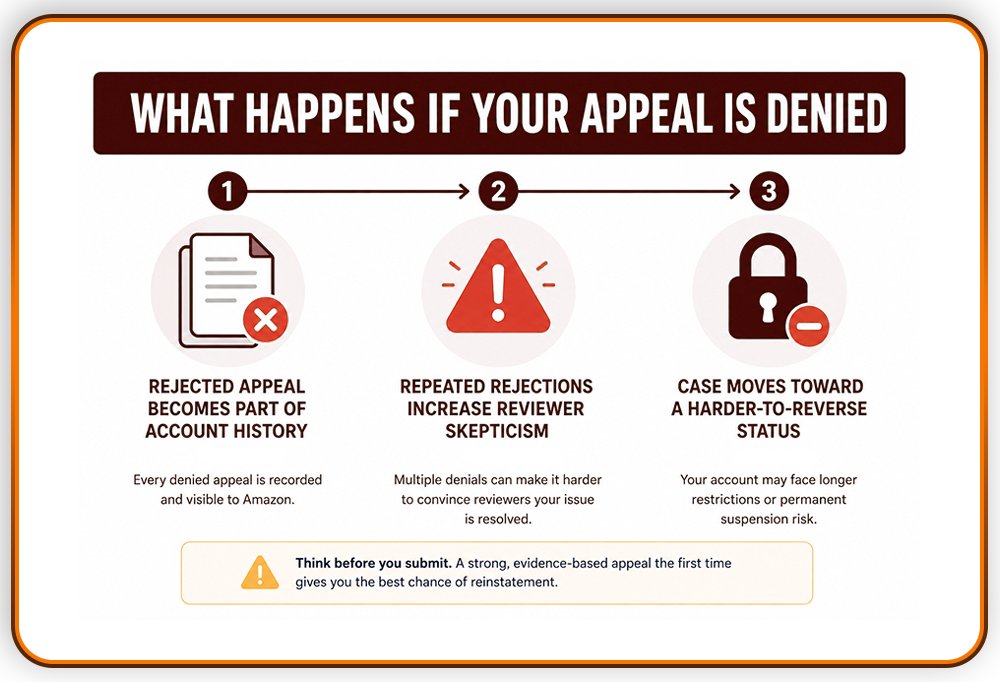
A denied Amazon appeal isn’t automatically the end of the road, but it isn’t nothing either. Most suspension types allow a limited number of appeal attempts before the case moves into a harder-to-reverse status, and every rejected submission becomes a permanent part of that account’s history that future reviewers can see.
That history matters more than most sellers expect. A pattern of several rejected Amazon appeals, especially ones that look similar to each other, can make a reviewer more skeptical of the next one, not less. This is exactly the point where continuing to resubmit variations of the same weak appeal stops being useful, and where getting an outside, honest read on what’s actually wrong with the case becomes the better next move than trying again alone.
How to Appeal an Amazon Suspension Effectively?
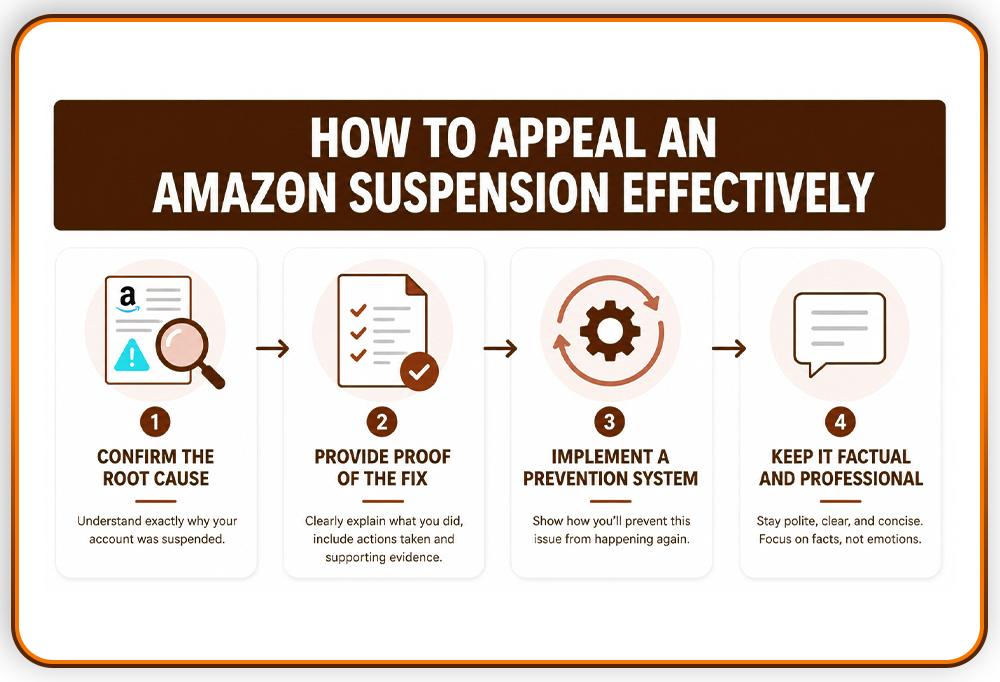
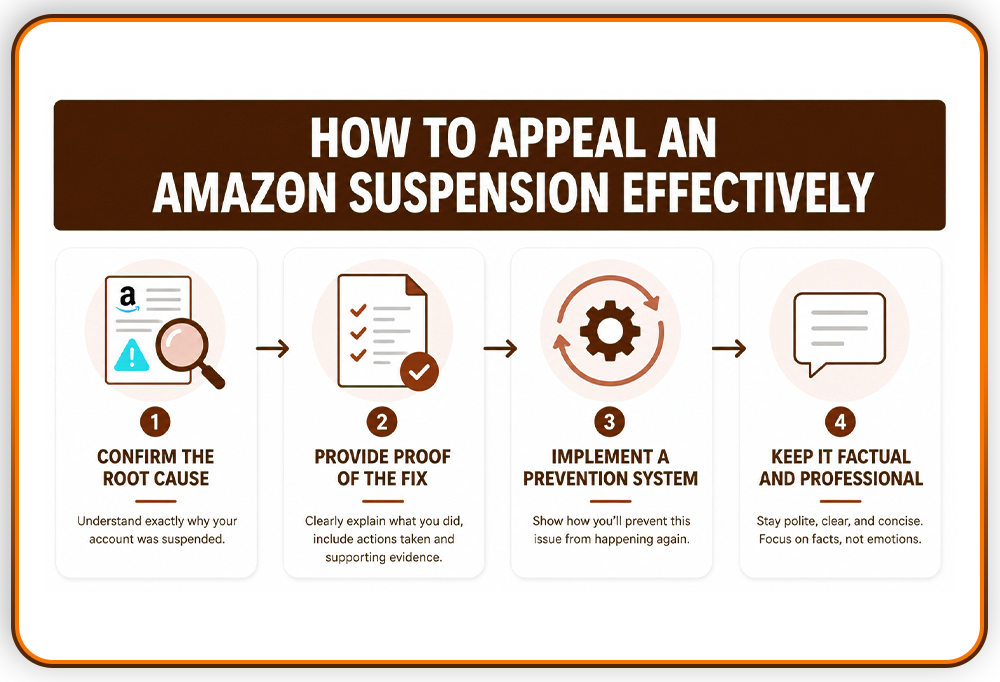
An effective Amazon appeal confirms the root cause, proves the fix with real evidence, and builds prevention as an actual system, not a promise. Staying evidence-first, not emotional, is what gets an Amazon suspension appeal passed instead of rejected.
1. Confirm the Real Root Cause First
Before writing anything, re-read the original violation notice slowly. Sellers under pressure tend to respond to what they assume the problem was rather than what Amazon actually flagged, and that one mismatch is enough to sink the whole appeal, no matter how well the rest is written.
2. Document the Fix With Proof
Show what was already done, not what will be done eventually, and back it with real evidence. If inventory was the issue, show the actual audit. If it was a supplier problem, show the corrected sourcing documents. A reviewer is checking for something verifiable, not something to take on faith.
3. Build a Real Prevention Process
Describe a system, not a promise. A new sign-off step, a checklist, a scheduled review, something that would still catch the issue even if nobody remembered to be careful next time. A single sentence saying “this won’t happen again” reads as unfinished, not reassuring.
4. Keep the Tone Factual Throughout
Center the whole appeal on the fix, not on whether the suspension felt fair. Even a legitimate grievance reads as defensive if it takes up space meant for evidence. Staying evidence-first through all three steps above is what separates an Amazon suspension appeal that gets scanned and passed from one that gets rejected in the first sixty seconds.
Conclusion
The Amazon appeal that gets rejected isn’t usually the one written by a careless seller. It’s often the one written by someone who did everything right emotionally and still missed what the system was actually built to check for. Amazon’s review process doesn’t reward the best explanation. It rewards the one that proves root cause, corrective action, and prevention in a format its reviewers can verify fast.
If you’re staring down another rejection and you’re not sure whether the next attempt will actually be different from the last one, that uncertainty is exactly what an honest reinstatement probability assessment is built to resolve before you spend another submission guessing.

FAQs
What is the Amazon appeal process for a suspended seller account?
The Amazon appeal process runs through Seller Central, where a Plan of Action needs to lay out root cause, corrective action, and prevention in that order. Missing any one of the three, or addressing the wrong root cause entirely, is what causes most rejections regardless of how detailed the rest of the appeal is.
How many times can I appeal an Amazon suspension?
Amazon doesn’t publish one universal number, but most suspension types have a practical limit before a case becomes significantly harder to reverse. Resubmitting the same unchanged Amazon suspension appeal repeatedly tends to hurt a case faster than it helps, since each rejection becomes part of the account’s visible history.
Does Amazon review every appeal manually?
Amazon uses a mix of automated screening and human review, with a heavy volume of daily submissions processed against standardized criteria rather than read individually start to finish. This is exactly why an Amazon appeal written to be scanned for specific elements performs better than one written to be read start to finish like a letter.
Can a well-written appeal still get rejected if the facts are true?
Yes, if it doesn’t clearly show root cause, corrective action, and prevention in a format Amazon can verify. Being truthful doesn’t help if the reviewer can’t confirm it against real evidence.
Should sellers hire someone to write their Amazon appeal, or handle it themselves?
Either can work if the appeal correctly identifies the root cause and includes verifiable proof. Where sellers most often struggle alone is misdiagnosing the actual cause, which no amount of good writing can fix.
One Response