
- admin
- Blog
How to Write an Amazon Intellectual Property Complaints Plan of Action
The email arrives with a subject line about intellectual property, and within minutes your best-selling ASIN is gone. Sometimes the whole account goes with it.
Most sellers who receive an Amazon copyright infringement email or a trademark complaint do the same thing. They open a search, find a general plan of action template, fill in their details, and submit. The rejection comes back days later with language about insufficient information, and they try again with slightly different wording.
The problem is that intellectual property complaints are not one category. Amazon handles trademark, copyright, patent, and design claims through different internal processes with different evidence requirements. A document that proves you sourced your products legitimately will not resolve a copyright claim about a product photo. A document explaining your supply chain will not resolve a patent claim about your product’s design. Writing one generic appeal for all four is the most common reason these cases drag on for months.
This guide covers how to classify the complaint you actually received, what evidence each type requires, when to pursue a retraction instead of an appeal, and how to write an Amazon Intellectual Property Complaints Plan of Action that addresses the specific claim in front of you.
What Should You Do If You Receive an IP Complaint on Amazon?
Before writing anything, take these steps in order. Most of the damage sellers do to their own cases happens in the first few hours.
1. Do not submit an appeal in panic, because a weak first submission is not neutral. It establishes a record, and each subsequent attempt is read against it.
2. Read the notice for four specific things. The complaint type, the name of the complainant, the specific ASINs affected, and any reference or complaint ID. Amazon often includes all four, though they can be buried in the message body.
3.Identify whether a person or a system filed it. This changes everything about your response, and it is covered in detail below.
4. Do not remove the listing before reading the notice fully. Deleting a listing can look like an admission and, in some cases, removes your ability to reference the original content in your defense. Deactivating is different from deleting, and deactivating is usually the correct step.
5. Do not contact the complainant with an argument. If you decide to pursue a retraction, the approach matters enormously, and an aggressive first message closes that door permanently.
6. Do not open a new seller account. Amazon’s linked account enforcement will find it, and it converts a recoverable listing problem into an account-level problem.
What Are the Common Intellectual Property Issues on Amazon?
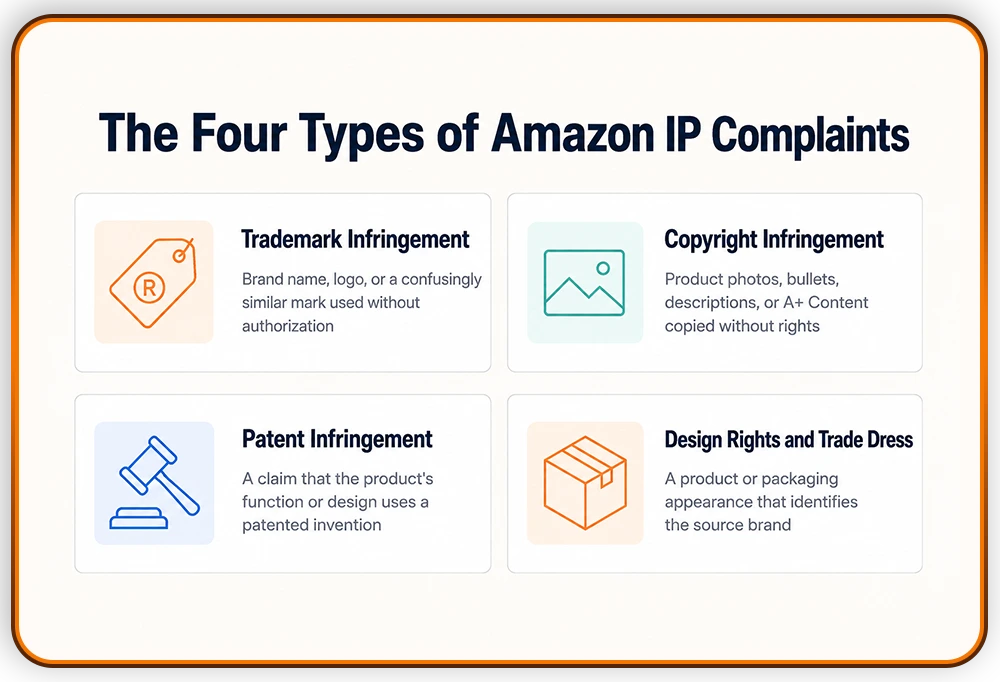
Four claim types account for nearly all Amazon intellectual property complaints. They look similar in the notification and are handled completely differently behind it.
1. Trademark Infringement
The most common type. A rights owner claims you used their brand name, logo, or a confusingly similar mark without authorization. This covers obvious cases like counterfeit branded goods, but it also covers situations that surprise legitimate sellers: using a brand name in your title when selling a compatible accessory, listing a genuine product under the wrong brand field, or describing your item as a replacement for a branded product.
Trademark claims are also where the first sale doctrine matters. Under United States law, someone who lawfully buys a genuine trademarked product can generally resell it without infringing the trademark. This is the legal basis under which most legitimate resellers operate. The doctrine has real limits, particularly around materially different goods, altered packaging, and products sold outside their intended market, but it is a genuine defense that many sellers do not know they have.
2. Copyright Infringement
A claim that you used someone else’s creative work. On Amazon this usually means product images, but it also covers bullet points, product descriptions, A+ Content, videos, and instruction manuals. Copying a competitor’s photo is the textbook case. Less obviously, using manufacturer-supplied images without documented permission can trigger a copyright claim, and so can a supplier who gave you images they did not own.
Copyright is the one category where a formal counter-notice process may apply, which is a different mechanism from a plan of action and is covered further down.
3. Patent Infringement
A claim that your product uses a patented invention. Utility patents cover how something works, design patents cover how it looks. Patent claims are the hardest to resolve inside Amazon’s process because the underlying question is genuinely legal rather than documentary. Amazon is not equipped to adjudicate patent validity, and its process reflects that.
4. Design Rights and Trade Dress
Claims about the visual appearance of a product or its packaging, where that appearance identifies the source. Less common than the other three but increasingly used by brands protecting distinctive product shapes.
The Distinction That Decides Your Entire Approach
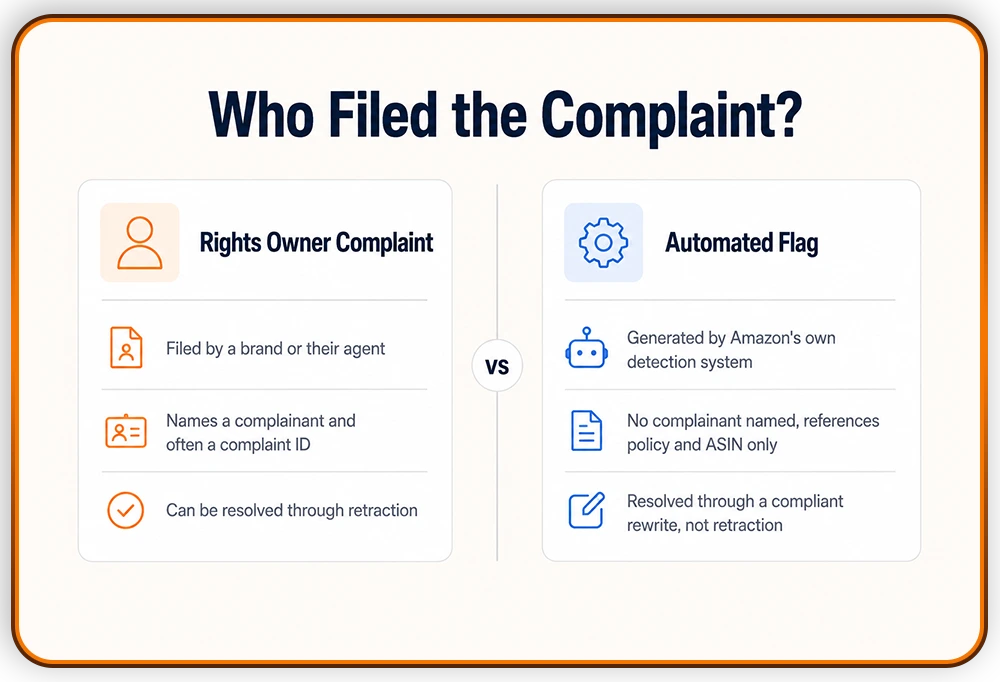
Here is the single most useful thing to understand about Amazon intellectual property complaints, and the thing most published guidance skips. Not every IP complaint comes from a person, it can also come from Amazon’s system. Here are the details:
Rights Owner Complaints
They are filed by a brand or their agent, usually through the Report a Violation tool inside Brand Registry. There is a real complainant with a name, a real allegation, and a real person who has the ability to withdraw it.
Automated Flags
These come from Amazon’s own systems. Amazon runs machine learning models that scan listings for suspected infringement, drawing on data supplied by enrolled brands. No complaint was filed. No brand owner is involved. A phrase in your title, a term in your bullets, or a similarity to a protected listing triggered a filter.
The reason this matters is that you cannot get a retraction for something nobody filed. Sellers routinely spend weeks trying to contact a rights owner who does not exist, on a complaint that was generated by an algorithm. Meanwhile, algorithmic suppressions are often the easiest category to resolve, because the fix is usually a compliant rewrite of the offending element rather than a documentary defense.
How to Differentiate: To tell them apart, check whether the notice names a complainant. Rights owner complaints identify the brand and usually provide contact information or a complaint ID. Automated flags reference the policy and the ASIN without naming any party. If your notice has no complainant, stop looking for one.
Retraction or Appeal? The Decision That Comes First
For rights owner complaints, you have two paths of retraction or an appeal, and choosing correctly saves weeks.
Retraction: A retraction is the complainant withdrawing the complaint. When it works, it is faster and cleaner than any appeal, because Amazon generally acts on a withdrawal without requiring you to prove anything further. Pursue a retraction when the complaint appears to be a misunderstanding, when you have documentation showing authorization, when the issue is a listing element you can correct, or when you have a genuine business relationship with the brand.
Appeal: An appeal to Amazon is the path when the complainant does not respond, refuses to retract, when the complaint came from an automated system, or when you believe the claim is factually wrong and you have evidence to prove it. You can pursue both. Sending a professional retraction request while preparing your appeal is usually the right sequence, as long as the retraction request does not contain admissions that undermine the appeal.
Amazon Intellectual Property Complaints Plan of Action: What Amazon Actually Looks For
An Amazon plan of action for infringement follows the same three-part root cause, corrective action, and prevention structure as any other appeal. What differs is the evidence, and the shift in emphasis is significant.
For most violation types, Amazon is assessing whether you have fixed a process. For intellectual property, Amazon is assessing something closer to a question of fact: are you actually entitled to sell this in this way?
That changes what the document needs to do. Performance appeals succeed on convincing prevention. IP appeals succeed on proof of entitlement. An Amazon plan of action for infringement that is full of excellent preventive measures will still fail if it never establishes your right to sell the product in the first place.
1. Root Cause for an Infringement Complaint
The root cause needs to name the specific listing element or sourcing decision that triggered the claim, and it needs to be honest about which of the two situations you are in.
- If the complaint is valid, say so plainly and specifically. "We listed our compatible phone case using the phrase 'for iPhone' in the title in a format that implied brand affiliation" is a root cause. It identifies exactly what was wrong.
- If the complaint is invalid, the root cause is different in kind. You are explaining why the claim does not apply rather than admitting a failure. "Our product is a genuine item purchased from an authorized distributor, and the complaint appears to relate to a listing element that has since been corrected" is a root cause statement for a non-infringement case.
Getting this wrong in either direction is costly. Admitting fault for something you did not do damages your position permanently and can be read as an admission. Denying a valid claim without evidence produces an immediate rejection.
2. Corrective Actions by Complaint Type
Corrective actions must be completed before you submit, written in past tense with dates. What they consist of depends entirely on the claim:
- Trademark: The infringing brand reference was removed from the title, bullets, description, images, and backend search terms. Sellers frequently correct the visible listing and forget the backend keywords, which are still checked.
- Copyright: The specific images or text removed and replaced with your own original content, with the replacement documented.
- Patent: In most cases, the listing is deactivated pending resolution because continuing to sell while a patent claim is open is difficult to defend.
- Design or trade dress: The packaging or presentation changed, with before-and-after documentation.
3. Prevention That Fits an IP Case
Preventive measures for infringement cases need to be specific to intellectual property risk rather than general compliance. A pre-listing IP check with a named owner. A documented authorization requirement before any branded product is listed. An image sourcing policy requiring written permission or original photography. A quarterly listing audit against your brand authorization records.
Each preventive measure needs a mechanism, an owner, and a frequency. Without all three it reads as a promise rather than a control.
The Evidence Each Complaint Type Requires
This is where IP appeals are won and lost, and where generic advice fails sellers most badly.
Trademark Complaint Evidence
- Supplier invoices meeting Amazon's documentation standards: dated within the last 365 days, showing supplier name, address, phone number and website, your buyer details matching your Seller Central account, item descriptions, and quantities that cover your actual sales volume for the ASIN.
- Authorization documentation, where you have it, such as a distribution agreement, reseller authorization, or written permission from the brand.
- Proof of authorized sourcing where you do not have direct brand authorization, establishing that your supplier was itself authorized.
- Corrected listing screenshots if the issue was a listing element rather than the product.
Copyright Complaint Evidence
- Proof of ownership or license for the content in question. If you commissioned the photography, the contract or invoice shows you own the output.
- Original creation records. Raw image files with metadata, drafts, or dated files are more persuasive than a claim of ownership.
- Written permission if you used manufacturer or supplier assets, ideally naming the specific images.
- Replacement documentation showing the disputed content is gone and what replaced it.
The trap in copyright cases is supplier-provided images. Many sellers use them in good faith, believing that receiving images from a supplier grants the right to use them. It does not, unless the supplier actually held those rights and passed them on. If you cannot document permission, the honest position is that you used the content without confirming rights and have now replaced it.
Patent Complaint Evidence
Patent claims are the category where the honest answer is that a plan of action alone often will not resolve it. Amazon’s internal process is not designed to determine whether a patent is valid or whether your product infringes it.
Realistic options include an invalidity or non-infringement opinion from a patent attorney, evidence of prior art, documentation that your product predates the patent, or a license if one exists. Amazon also operates a neutral patent evaluation process for certain utility patent disputes, which produces a determination from a third-party evaluator rather than from Amazon.
If you face a patent claim on a significant product, this is the point at which qualified legal advice is worth more than a better-written appeal.
Automated Flag Evidence
Almost none of the above applies. What you need is identification of the trigger and a compliant rewrite. Work through the title, bullets, description, images, and backend search terms looking for the brand name, a protected phrase, or a term that implies affiliation. Then rewrite it in a form that does not.
The Copyright Counter-Notice: A Separate Path
For copyright claims specifically, there is a mechanism distinct from a plan of action that most seller-facing content does not mention.
A counter-notice is a formal statement asserting that content was removed in error or misidentified. It carries legal weight and legal consequence. It typically requires you to identify the removed material, state under penalty of perjury that you believe the removal was a mistake, and consent to jurisdiction in a specified court.
That last part is why this path deserves caution. A counter-notice can expose you to litigation from the complainant, and the statement is made under penalty of perjury. It is the right tool when you genuinely own the content and can prove it. It is the wrong tool when you are uncertain, and filing one to buy time is a serious mistake.
If the content is genuinely yours and you have the records, a counter-notice can be more effective than an appeal. If there is any doubt, replace the content and appeal instead.
Amazon Intellectual Property Complaints Plan of Action: Worked Example
The example below covers a trademark complaint where the product is genuine and the issue was a listing element. Read it for structure and specificity. Copying it will not work, for reasons explained after.
Subject: Plan of Action, trademark complaint, ASIN B0XXXXXXXX
Complaint reference: [ID from the notice] Complainant: [Brand name as stated in the notice]
1. Root Cause
We received a trademark infringement complaint on ASIN B0XXXXXXXX from [brand]. On review we identified that our listing title read “Replacement Filter for [Brand] Model X, [Brand] Compatible” and our backend search terms included the brand name four times.
Our product is a genuine third-party compatible filter that we manufacture. The product itself does not infringe. Our listing, however, used the brand name in a position and frequency that could imply an affiliation or endorsement that does not exist.
The underlying cause was a process gap. Our listing creation checklist covered image and content requirements but had no step verifying how third-party brand names were used in titles and backend terms. Six other ASINs in our catalog were created under the same checklist and carried the same risk.
2. Corrective actions completed
-On [date] we deactivated ASIN B0XXXXXXXX.
-On [date] we revised the title to “Replacement Water Filter, Compatible with Model X,” removing the brand name from the title entirely.
-On [date] we removed all brand references from the backend search terms. Before and after screenshots are attached.
-On [date] we audited the six other ASINs created under the same checklist and applied the same corrections. A summary of the changes is attached.
-On [date] we contacted [brand] to confirm the corrections and request withdrawal of the complaint. Correspondence is attached.
3.Preventive measures implemented
-As of [date], our listing creation checklist includes a mandatory brand reference review. No listing is published until a second reviewer confirms that third-party brand names appear only in compliant compatibility statements and never in the title or backend terms. Our catalog manager owns this step.
-We have documented an internal standard for compatibility language, based on Amazon’s listing policies, and trained our two catalog staff members on it. The standard and the training record are attached.
-Our catalog manager audits all active listings against this standard on the first Monday of each quarter and records the audit in our compliance log.
-We have added a brand authorization field to our product onboarding form. Any product referencing a third-party brand now requires documented review before listing.
Attachments: before-and-after listing screenshots, catalog audit summary, correspondence with the rights owner, internal compatibility standard, training record.
Why This Cannot Be Copied As-Is
Look at what makes that document work. It names the exact phrase that caused the problem. It counts the backend occurrences. It identifies six other ASINs at risk and confirms they were fixed. It distinguishes between the product, which was fine, and the listing, which was not.
Reviewers see recycled appeal language constantly, and a submission that pattern-matches to a template gets less serious consideration, not more. You can use the structure, but do your own investigation.
How to Avoid IP Complaints on Amazon
Prevention is genuinely more tractable here than in most compliance areas, because the majority of IP complaints against legitimate sellers trace to a small number of avoidable practices.
1. Use Brand Names Correctly: Never use a brand name in your title unless you actually sell that brand. For compatible products, mention compatibility factually in the bullets without implying endorsement or affiliation.
2. Audit Backend Search Terms: Review your backend search terms regularly and remove third-party brand names that aren’t necessary or authorized. This is a common blind spot because sellers often clean up visible content while overlooking backend terms.
3. Use Original Product Photography: Photograph your own products whenever possible to reduce copyright exposure and create more distinctive, trustworthy listings.
4. Get Image Rights in Writing: If you use supplier or manufacturer images, obtain written confirmation that the rights holder authorizes you to use them and keep that documentation for your records.
5. Document Your Supply Chain: Keep compliant invoices and purchase records organized before you need them. Verify that your supplier documentation meets Amazon’s requirements while your business relationship is active.
6. Check Patents Before Launch: Conduct a basic patent search before launching products with distinctive mechanisms, designs, or features. For higher-risk products, consider professional patent advice before investing in inventory.
7. Use the Generic Brand Field Correctly: Never list a branded product as “Generic” or use an incorrect brand name. Accurate brand information helps prevent both IP-related complaints and catalog enforcement issues.
How Can You Set Up IP Alerts for Your Amazon Seller Account?
There is no notification setting in Seller Central that warns you before an IP complaint arrives. What exists is a set of monitoring practices and, for brand owners, a set of Amazon tools.
- Enable Account Health Notifications: Turn on email notifications in Seller Central and check the Account Health page weekly rather than relying on email alone. Policy notifications typically appear there first.
- Enroll in Brand Registry: For brand owners, Brand Registry provides access to Amazon's brand protection tools, including Report a Violation, while strengthening the automated protections applied to your listings. It is primarily designed to protect your IP rather than warn you about claims against your account.
- Use Third-Party Listing Monitors: Monitoring tools can track listing changes, new sellers appearing on your ASINs, and unauthorized content modifications. These alerts can help identify hijacking or changes that may lead to IP disputes.
- Conduct a Quarterly Self-Audit: Review your listings against your IP prevention checklist at least once every quarter. Regular audits can help identify potential trademark, copyright, or patent issues before they result in a complaint.
If a complaint has already arrived, the first 48 hours shape the outcome more than anything you do afterward. SPCTEK’s guidance on responding to complaints covers the immediate sequence.
What to Do When Your IP Appeal Is Rejected
Rejections in IP cases usually carry more signal than sellers realize.
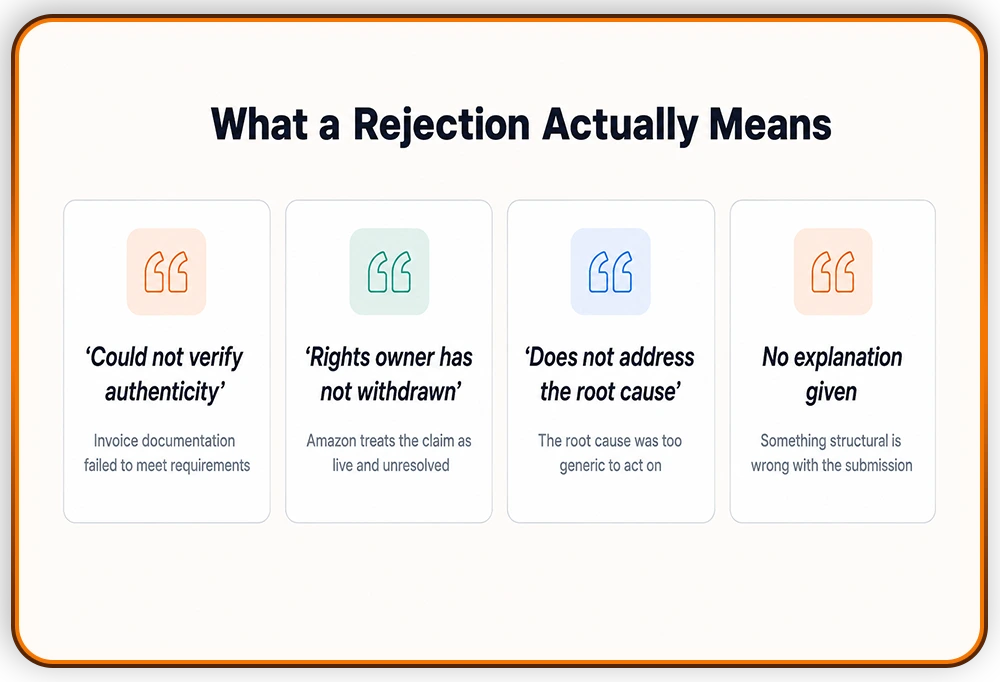
- "We could not verify the authenticity of your products" means the invoice documentation failed. Most often the quantities do not cover your sales volume, or the supplier could not be verified. This is a documentation problem, not a writing problem.
- "The rights owner has not withdrawn the complaint" means Amazon is treating the claim as live and unresolved. Your path is either a retraction or evidence strong enough to overcome the claim without one.
- "Your appeal does not sufficiently address the root cause" almost always means your root cause was generic. Rewrite it with specifics rather than resubmitting the same document with softer language.
- No Explanation:A rejection with no explanation is the hardest. Do not resubmit the same document. Something structural is wrong, such as the wrong evidence type for the claim, an unaddressed element of the complaint, or a misclassification of what you were accused of.
Resubmitting a rejected appeal with minor edits is the most common pattern in prolonged cases and one of the least effective. Each cycle without a substantive change costs you time and credibility.
When to Get Professional Help
Handle it yourself when the complaint is a single listing element you have already identified, your documentation is in order, and the claim is straightforward.
Consider professional help when the complaint is a patent claim on a meaningful product, when the rights owner has refused to retract, and you believe the claim is wrong, when multiple appeals have been rejected without clear explanation, when the complaint has escalated from listing level to account level, or when you are considering a counter-notice and are not certain of your position.
For patent disputes and counter-notices specifically, the right help is legal rather than consulting. These involve legal determinations and legal exposure, and a reinstatement service is not a substitute for an attorney in either.

Frequently Asked Questions
What should I do first if I receive an IP complaint on Amazon?
Read the notice and identify the complaint type, the complainant, and the affected ASINs before doing anything else. Do not submit an appeal, delete the listing, or contact the complainant until you know whether a rights owner or an automated system generated the claim.
How long do I have to respond to an Amazon IP complaint?
The deadline is stated in your notice and varies by complaint and enforcement type. Use the one in your own notification rather than a figure you find online. Amazon does not publish a universal response window for IP complaints.
Can I get an IP complaint removed from my account?
Yes, in two ways. A retraction from the rights owner generally removes the complaint. A successful appeal can also result in the violation being removed from your account health record, which restores the points it cost your Account Health Rating.
What is a retraction, and how do I get one?
A retraction is the complainant formally withdrawing the complaint through Brand Registry. You get one by contacting the rights owner with a short, factual message that identifies what you have already corrected and asks specifically for withdrawal. Aggressive or argumentative messages rarely produce retractions.
Does an IP complaint affect my Account Health Rating?
Yes, intellectual property violations are recorded as policy compliance violations and deduct points from your AHR. Successfully resolving the violation restores the deducted points.
How many IP complaints does it take to get suspended?
Amazon does not publish a threshold. Multiple unresolved complaints in a short period substantially increase the risk of account-level action, and a single complaint in a severe category can be enough. Unresolved complaints are the risk factor, not the count alone.